S-1

Some companies have a soul, others are just going through the motions.

Get new studies by email.via Substack ↗
Moats & Pricing Power

Pricing Power : A Double Edged Sword

October 21, 2026

“The essence of what’s going on here, of course, is we have a corporation that was in a branch of the newspaper business, and our branch of the newspaper business, like most newspaper businesses, has gone to hell compared to what it was in its peak years. And almost every other newspaper business is going to hell with no pardon, they’re just disappearing. What we have is this computer software business where we’re serving the same customers to some extent, except now they’re all over the country, even some of them outside the country, with this...we were selling software to all these courts and public agencies, whereas before we were giving information to lawyers and other people and publishing public notices.

And our software business is of a type where it’s a long, tough slog, but we’re slogging very well and we really love the people who are doing it for us. We’ve got a lot of wonderful people and in our software business, the implementers and the computer programmers and the people that deal with the public agencies, and the ethos of the place is very admirable. Everybody’s trying to get ahead here by doing the work right and serving the customers right and having a lot of financial wherewithal where money is never a problem and doing what we’re supposed to do. And so, it’s a pleasure to people like Rick Guerin and myself to watch all these young people doing this, and of course we’re very glad to be able to do it when we should be dead [laughter].”

Charlie Munger on the DJCO software business, DJCO Annual Meeting (2017)

Fall is when a business’s future gets decided

Fall is a wonderful time of year, especially in a place like Michigan where you get all four seasons. Leaves become vibrant colors, and one can admire the beauty of nature. Fall in a business analogy is a period of decline for a business, where a once profitable business has either matured and growth has plateaued, or has begun its decline as technology brings change, and goes out with the old, in with the new.

Fall in the business cycle is the crucial period in which a firm’s future existence is decided. If a business cannot scramble and use the declining cash cow to fund a transition to a new business leveraging existing strengths, then they will be all but a nostalgic corporate relic. The last few decades of DJCO have been in such a rebirth, leveraging the dying newspaper business and leveraging their strength in selling information to lawyers to create software to modernize the analog information they once sold to the courts.

The Rebirth of the Daily Journal, From Its Own FilingsFiscal years ended September 30; $ in thousands
FY 2009FY 2017FY 2025
Traditional Business revenue (newspapers, public notices)35,48117,57017,762
Journal Technologies revenue (court software)4,94323,81469,938
Total revenues40,42441,38487,700
Software share of revenue (computed)12%58%80%
Traditional Business pretax income12,931(360)(165)
Journal Technologies pretax income17(12,142)12,660
Net income (loss)8,026(918)112,137
Cash and marketable securities62,127232,649513,564

In fiscal 2009 the software segment was reported as "Sustain"; it merged with New Dawn and ISD on October 1, 2014 to form Journal Technologies (FY 2017 10-K). FY 2009 liquidity is cash plus U.S. Treasury notes and bills plus marketable securities, as grouped in that 10-K; FY 2017 and FY 2025 are cash plus marketable securities at fair value. Net income in FY 2025 and FY 2017 includes realized and unrealized gains and losses on marketable securities. Software share row computed from the filed figures above.

Sources: Daily Journal Corp. Form 10-K for fiscal 2009 (filed December 15, 2009), fiscal 2017 (filed December 13, 2017), and fiscal 2025 (filed December 29, 2025), SEC EDGAR, CIK 0000783412.

DJCO is a great example of a successful transition into a new business, leveraging an existing strength. The key formula to successfully transition into a new technology millennium is existing capital, often through a declining profit center, + an existing strength which gives you the ability to create the new business. Without the existing strength, you're just a well-funded startup. The key advantage is your existing strength. DJCO was selling newspapers to lawyers and firms, which gave them important information about courts. So having these relationships with the courts proved key when they began to sell software to modernize the courts and their data.
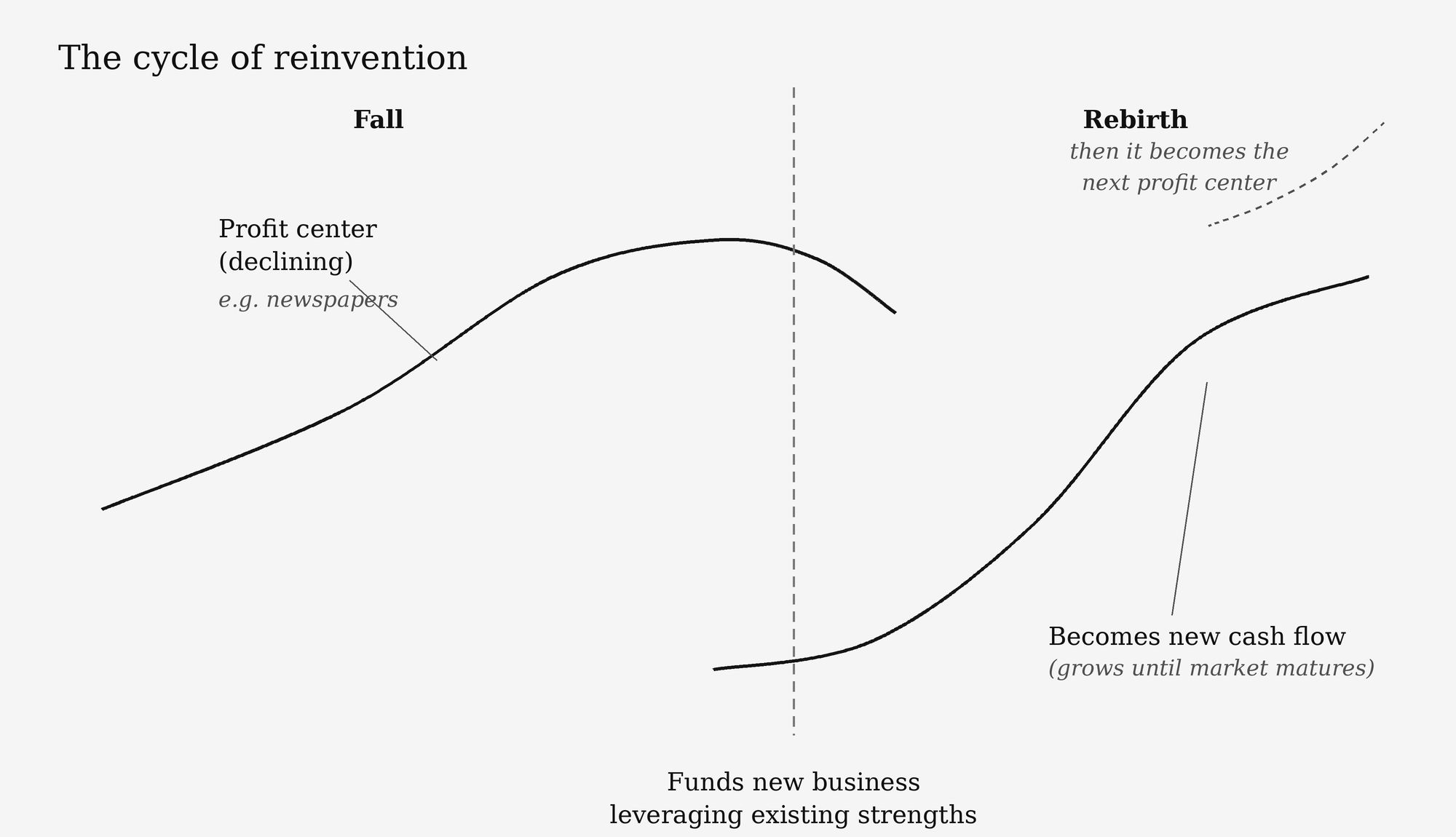
The cycle of reinvention

Untapped pricing power is the asset

Would you rather own a firm which is constantly increasing prices, and its customers for the most part, until recently have dealt with it, and the firm’s revenues and profits have increased dramatically?

Or would you own a firm that has increased the price very little, if at all, yet has great customer relationships, and a well-known brand?

The answer is, most obviously, the latter. Untapped pricing power is a phenomenal state for a firm to be in when you invest. You are at a point where you have created much intangible equity with your customers, where you can implement great price increases in excess of inflation and see little to no backlash. Truly, the market is your oyster.

Pricing power also has hierarchies, and it is important for management to understand where the present business actually stands within the implied hierarchy. Overestimate pricing power and your customers will engineer a new solution that routes around you. Underestimate, and you may be considered incompetent, but at least the business retains the intangible equity. If anything, delayed gratification is good; Costco is a good example of this: they have disciplined management that raises prices only every few years, and if so, nominally to keep pace with inflation. This is long-term accretive because it keeps existing customers extremely loyal and allows for new customers to join by keeping barriers low. Over time, customer dependence increases, making it harder to churn in the future if management chooses to tap pricing power.

There are really two ways to assess the effect on shareholders’ returns due to pricing power. Either you buy an ownership position in a business when the pricing power is untapped, and you see a catalyst, or management has begun to raise prices. The obvious benefit is that the increased revenue growth and increase in the bottom line will drive your return over the long term.

Another indirect way to leverage pricing power is to use the Costco model and basically create all the scenarios for untapped pricing power, but delay it through the concept of “Scale Economies Shared” (Nick Sleep), and let the market realize the beauty of your business and therefore receive a premium in your valuation.
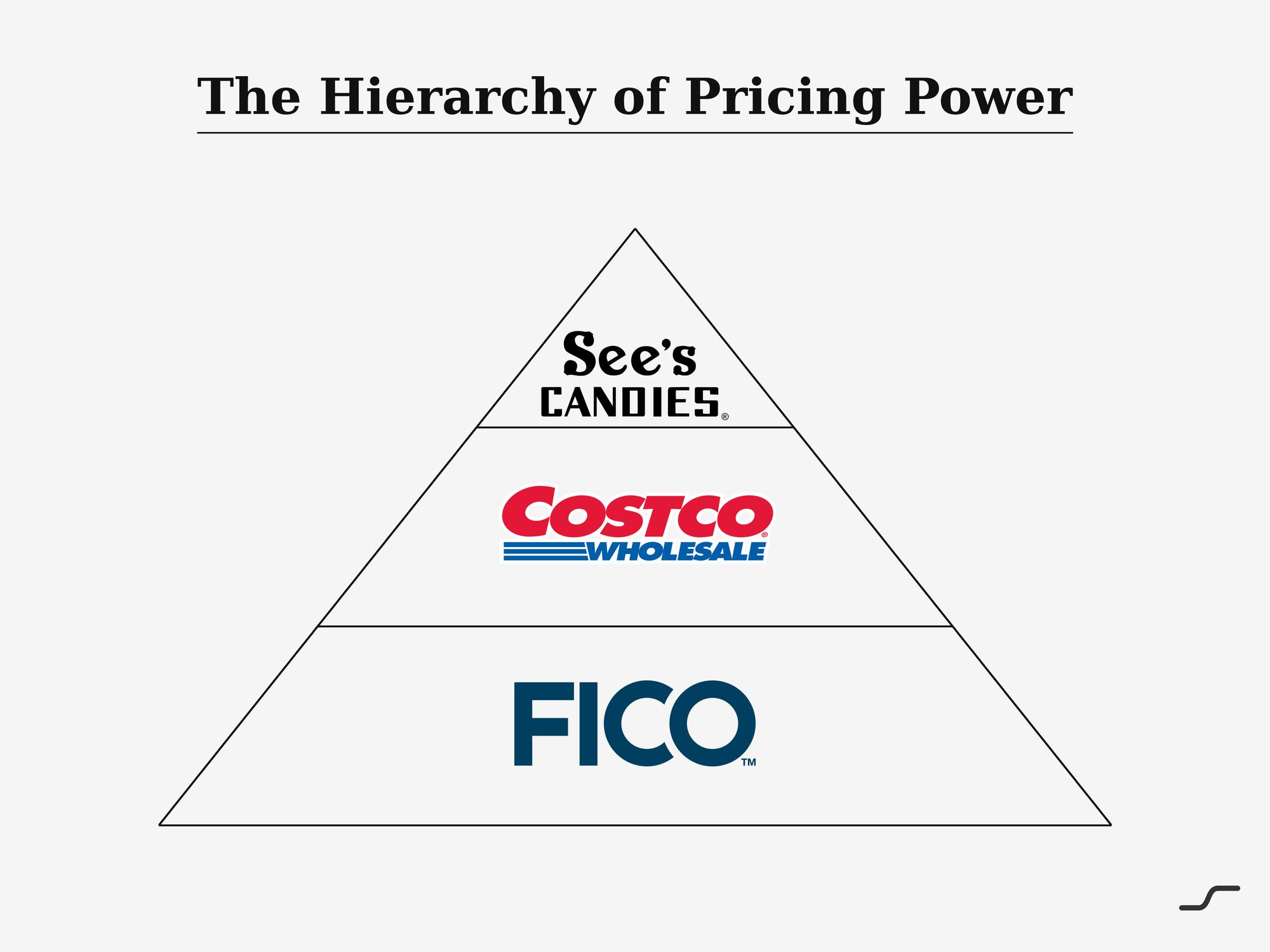
The hierarchy of pricing power

FICO: the role model for the worse

Costco and See’s Candies are examples of the good, but who is a role model for the worse?

Fair Isaac Corporation (FICO) comes to mind. You have to place yourself in the shoes of a mortgage company and think: you probably are annoyed that a cut of your transactions goes to FICO for their scoring services. That should tell you that FICO most definitely did not have the level of pricing power that See’s Candies does. Maybe someone should have alerted present management to this when they went on a spree of price hikes over the last decade or so. Forcing regulators to introduce the 2018 Credit Score Competition Act, allowing new competition, which they validated in 2022 with VantageScore 4.0.

With new competition, prices will inevitably decline, and for the foreseeable future, the Scores business should decline. The decline will be a long one, because there are deep institutional ties; this business will not disappear overnight. Equifax is slashing prices to $4.50, half of FICO. Clearly, the business will not disappear overnight, which is the beauty of the situation. FICO’s scoring business makes up roughly 80% of its segment operating profit, with little capex attributable; the high-margin business can safely fund the SaaS expansion over the next decade.

The declining scores business funds the software rebirth

The SaaS business is where DJCO collides. Similar to the DJCO story, FICO management has built a new SaaS business platform which is growing, and they are actively moving away from the legacy non-platform SaaS business.

FICO software revenue, platform vs. non-platformYear ended September 30; $ in thousands
202320242025
Platform software154,750200,004237,056
Non-platform software485,432511,336503,089
Total640,182711,340740,145
Platform share of software revenue24%28%32%

Source: Fair Isaac Corporation, Form 10-K for fiscal 2025 (filed November 2025), SEC EDGAR, CIK 0000814547.

Platform software, which is the new cloud-based software business that sells analytics to the same customers, credit bureaus, etc. The platform helps customers manage data, fraud protection, etc. Leveraging the existing customer base and leveraging the same model analysis and customer integration from the scores business to sell similar modular capabilities on a recurring revenue basis, plus additional usage fees for specific contracts.

A new business is not a new business model

There are real differences between developing a new business, and a new business model. Amazon building AWS is a new business, whereas creating an ads marketplace is a new business model. It is far easier to create a new business model to extract value on an existing customer value proposition in the short term. But in the long run the value extraction will be net-negative on the sustainability of profits of the business if the additional business model has no customer benefit. Building a new business leveraging existing strengths allows for greater sustainable profits, short term upfront investment but greater longer term longevity within the new business.

Not every set of management is capable of such a transformation, simply because it is difficult and requires accountability. It is far easier to introduce a subscription product or an ad product on an existing marketplace, then build a new business if necessary.

You can commend Mark Zuckerberg as a great example of this, but there is a fine line between conviction and stupidity.

FICO is interesting because it represents an entire palette of investing and business ideas. It has a cult value investor following for all the dying legacy reasons; it has a turnaround story (Who doesn't love a good turnaround story? I sure do…), and it has one of those scary yet innocent fables for what can happen when management overestimates pricing power. It really has it all.

For informational purposes only. Not investment advice.

Sources

Daily Journal Corp., Form 10-K, fiscal 2025

Daily Journal Corp., Form 10-K, fiscal 2017

Daily Journal Corp., Form 10-K, fiscal 2009

Fair Isaac Corporation, Form 10-K, fiscal 2025

Equifax press release, October 7, 2025: VantageScore 4.0 at $4.50

Economic Growth, Regulatory Relief, and Consumer Protection Act (S.2155, 2018), Sec. 310, Credit Score Competition

Charlie Munger, Daily Journal Corporation Annual Meeting transcript, 2017
Moats & Pricing Power

Trust Is the Moat

How do I invest?

October 5, 2026

I am writing this more for myself than for anything else. I believe it is important to have a clear idea of what my ideas are, simply for reference and record.

Investing over decades

I invest over many decades.

This works for me because of my own independent structure. Mutual funds, hedge funds, other institutional vehicles, etc., cannot, because of their structure, which forces them to constantly have to find new ideas and sell old ones.

Unless you have a permanent capital vehicle, which really only works if you’re really small and you’re a closed partnership, for which you must earn much trust from family, friends, and colleagues, or you have immense record, skill, and status, which allows you to have leverage when establishing a fund. Chris Hohn of TCI is a prime example. Also, taking control of a textile manufacturing company and compounding it for decades seems to work okay.

Beyond that, investing over decades really requires a few things. A combination of extreme patience and focus, and the ability to stomach a lot of pain. The other is having great experience and understanding long-term qualitative aspects, which cannot really be modelled in Excel, and realizing how rare they truly are.

Coinbase and customer trust

A great example of this is Coinbase. Anything crypto-related tends to brush a value investor the wrong way, so brace yourself. Coinbase has a lot of the qualitative ideas of a firm I would want to own for decades, if not forever.

It is always good to start with management, listening and reading what they have to say. The best management tends to think really long term, is motivated beyond just monetary needs (they tend to have enough), and is motivated by their vision of the world or industry they are trying to impact. As Armstrong describes, making a dent in the universe. The key example in this scenario is forgoing short-term profits for long-term profits and, instead of earning Wall Street satisfaction in the short term, compounding customer trust.

In a new asset class such as crypto, it is easy to fool, trick, and deceive to make a quick buck. Many have, and got away with it; others have not. A prominent competitor to Coinbase, which was a derivatives trading platform, misused customers’ trust and set the entire industry back.

Coinbase and Armstrong want to do the opposite; they are willing to forgo short-term fads that could make them great amounts and lose their customers great sums, and rather prioritize customers and their investments.

Brands tend to have different utilities; some signal to the world that the owner is sophisticated and of value, while others showcase trust. Different brand utilities command greater pricing power. The best brands in the long run tend to have a combination of great history, significant utility (whether it signals status or has great product quality), and trust that it delivers on its company promise.

Figure 1

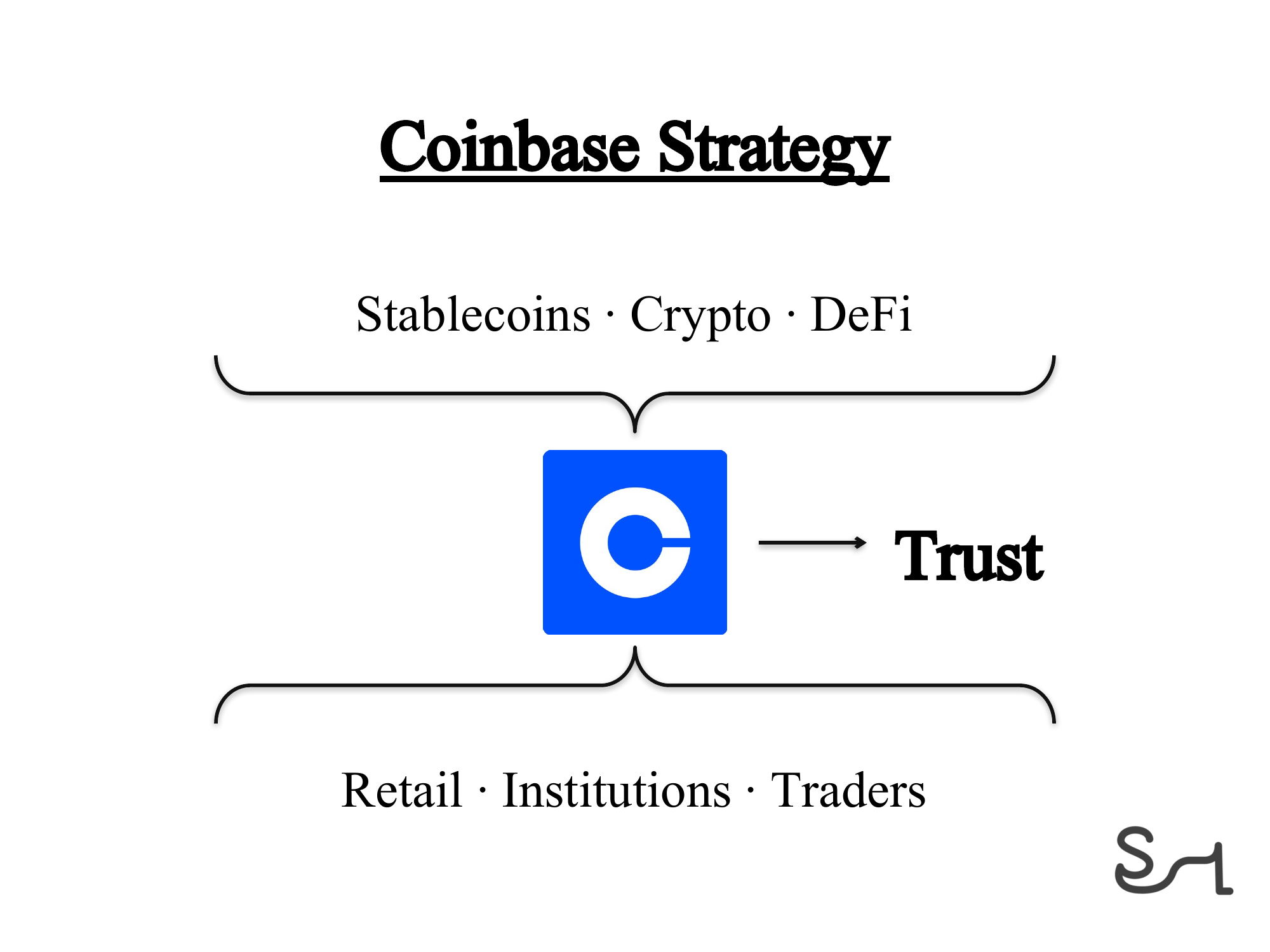
A common example that Munger uses is Wrigley’s gum, akin to a foreign competitor that is 20c cheaper. Coinbase is really a trust enabler. They have, in a new and volatile industry, been a benefactor for both retail and, more recently, institutional investors. This is why they have such great long-term potential to compound in an ever-growing industry as technology is actively improving the financial world.

Differentiation and pricing power

I often think of Robinhood as a competitor. Which is incorrect; Robinhood is a one-layer play on a traditional service that incumbents dominate, leveraging a new technology wave. They will likely be acquired when their growth matures, because they really are a feature. A good business, just better suited within a larger financial institution. Coinbase is two layers deep, pioneering crypto while using mobile technology. Hence the potential for long-term compounding. The distinction is key: the greater the independence, and the difficulty of replication, the greater the pricing power. Josh Tarasoff talks about pricing power in three ways, the first being where a firm has no pricing power. Then nominal pricing power, where a firm can raise prices to keep pace with inflation; this is where Robinhood lies in the long run, at least on its own. Then there is excess pricing power, which is for great businesses with true differentiation; Coinbase is as such.

The future is cryptographic, for a ton of reasons.

The vision of management is bold and brilliant, yet somehow extremely grounded and long-term. Listening to Brian, you can tell he is grounded in the long term, willing to let competitors extract short-term value at the cost of their brands in the long run.

Coinbase takes the long-term approach; the acquisition of Deribit gives them an institutional business, albeit at a very high price, yet a necessary one, to prevent a competitor from owning it, since now Coinbase is the most trusted place for retail investors and institutional investors. Deribit is the clearest example. Coinbase paid about $4.3 billion at closing, up from the roughly $2.9 billion announced, because its share price rose. It was the largest acquisition in crypto at the time. Kraken had been in talks to buy Deribit for months and ended up buying NinjaTrader for $1.5 billion instead. It was a high price, but it bought the leading crypto options exchange, which handled over $1 trillion in volume the year before. (Source: Coinbase Global, Inc., Form 10-Q for the quarter ended September 30, 2025, Note 3, “Acquisitions - Deribit”, filed Oct. 30, 2025, https://www.sec.gov/Archives/edgar/data/1679788/000167978825000208/coin-20250930.htm) As the asset class grows, and institutions continue to trade crypto and broader commodities with the growth in prediction contracts, Coinbase will stand to benefit. They constantly introduce new financial products that leverage blockchain innovation, such as tokenized stocks. The goal is to make economic freedom available all around the world.

Diversifying beyond transaction revenue

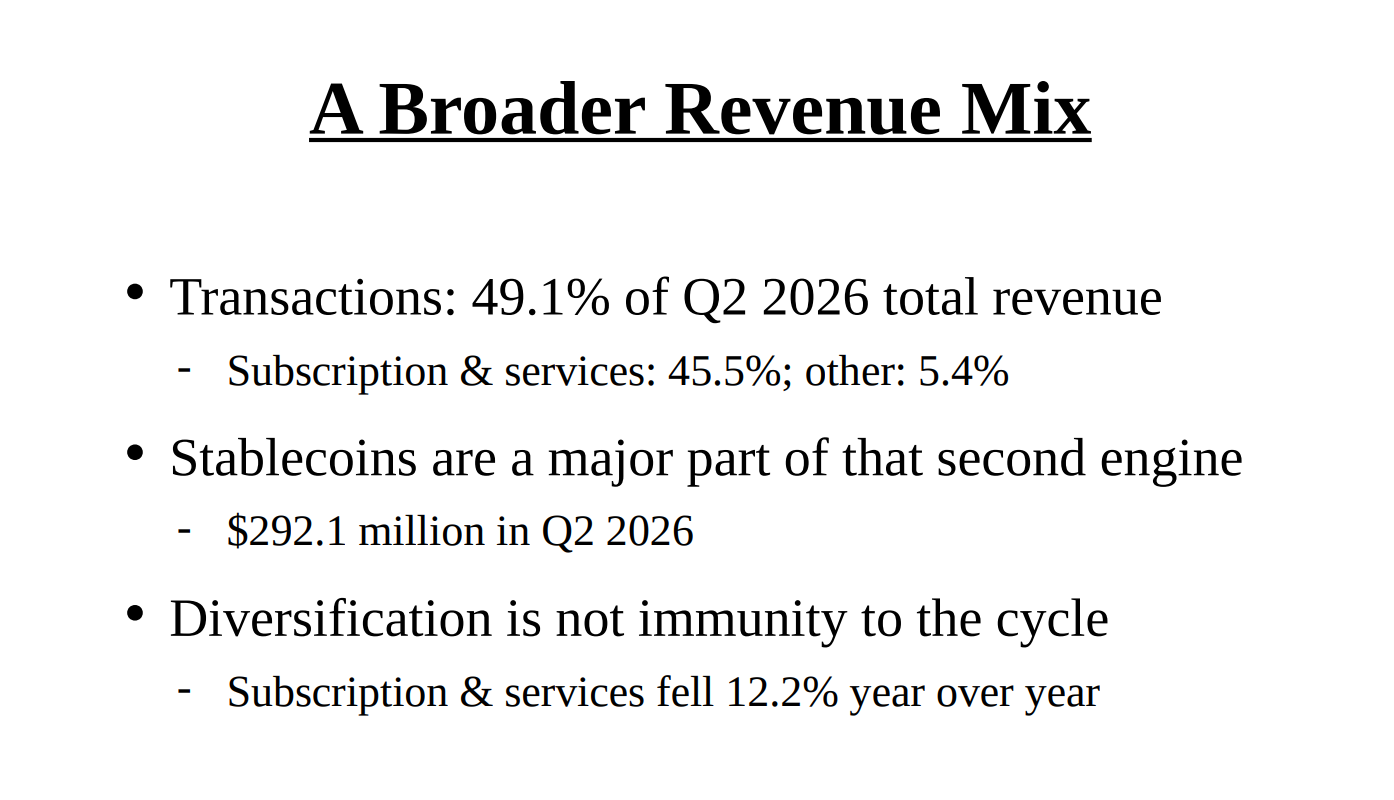
While the market still heavily links Coinbase to the trends of cryptocurrencies, Coinbase has successfully diversified, leveraging the growth and regulatory approval of stablecoins and introducing a subscription business.

This has stabilized its once heavily dependent transaction-revenue business. In Q2 2026, transaction revenue was around 50% of net revenue, with the rest being interest income and subscription revenue.

We hit an all-time high in the number of Paid Coinbase One Subscribers by introducing new tiers and increasing the value proposition with products like Coinbase One Card. Our ability to scale and diversify is driving results; we now have 12 products that generate more than $100 million in revenue on an annualized basis, half of which generate more than $250 million, and two that generate more than $1 billion.

Coinbase Shareholder Letter Q4 2025. The 12-product figures are measured using quarterly annualized net revenue for each product's most recent qualifying quarter, not full-year revenue.

Brian says and does the right things that many other CEOs have reminded me of, such as Bezos. He is committed to doing the correct thing, which will benefit shareholders in the long run, avoiding traps that may be beneficial in the short term but destructive to the brand in the long run.

The brand is the clear pillar of this company; as goes the brand, so goes the company.

Coinbase facilitates trust for institutions and retailers who want to invest in crypto, a $2.9 trillion asset class (as of Oct 4, 2026). Coinbase holds bitcoin, showing its trust in the innovation. It is not a debate whether bitcoin is a better option than the dollar; inflation will be a problem of the past, and Coinbase stands to benefit.

While recent fiscal quarters have struggled due to the broader crypto market, the continued diversification and recurring revenue and profits of Coinbase in the long run will prove well.

Figure 3

Management determines how long trust lasts

Overall, Coinbase is an example of an interesting concept. The intangible value of Coinbase’s brand enables trust. Trust therefore enables pricing power, since it is the key differentiation between Coinbase and other smaller, less-known crypto platforms. Coinbase's pricing power is the key enabler of long-term cash flows that will compound the firm's value. Other firms can do the same in technology waves: those that build trust with consumers and enterprises and constantly regain the relationship.

An example of this is IBM, which built great trust in the early pc era; when Gerstner arrived in the 90s, they were able to regain this relationship by building a services business which helped the same enterprises deploy this technology. Hence, this concept of trust is one of the strongest kinds of brands.

However, a brand and trust can always be destroyed through poor actions. Thus, the management team of the firm you believe has this brand power plays a crucial role, as they decide how long this valuable brand image, which enables pricing power, which in turn enables long-term cash flows of the business, will last. In my judgment, this character and long-term owner-minded thinking exists within Coinbase management, which begins with Armstrong. I look forward to enjoying seeing the value of Coinbase compound.

For informational purposes only. Not investment advice.

Sources

https://www.sec.gov/Archives/edgar/data/1679788/000167978825000208/coin-20250930.htm

M&A & Consolidation

Ride-sharing & Delivery Consolidation

Enterprise Software & World Domination

September 26, 2026
Figure 1

Uber’s consolidation opportunity

Always fun to think about Uber’s long-term prospects. When a company's market starts to mature, m&a can be a double-edged sword, either increasing this growth or hurting it. Uber has such an opportunity.

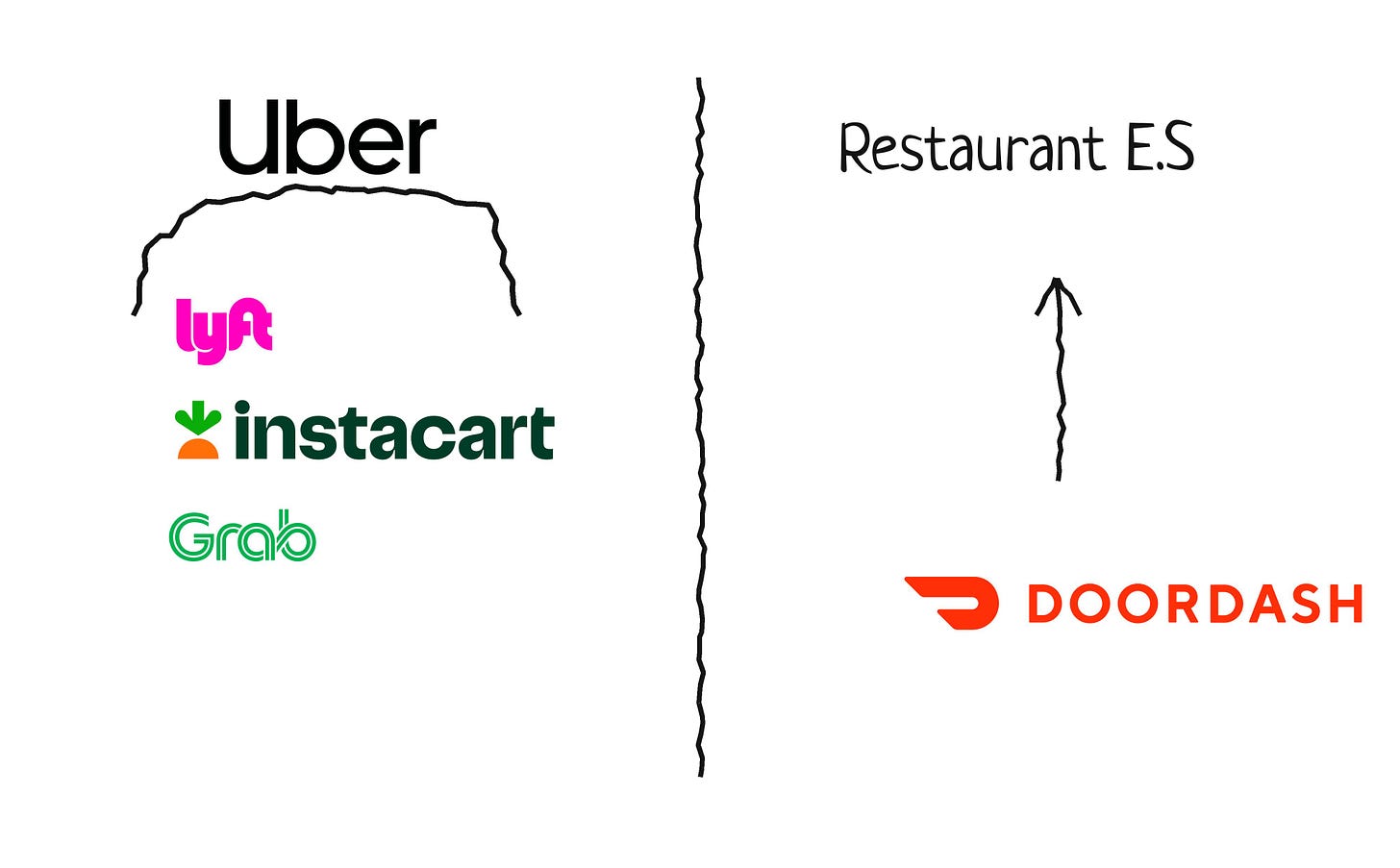
Uber should acquire struggling “one-market” delivery companies. DoorDash should sell enterprise software to restaurants.

The key idea is that DoorDash and Uber seem to be on an inevitable collision course when they cap out growth in their respective markets. Yet they are both large enough to build better and bigger businesses while going in completely different ways. Uber has the largest Driver - Rider - Orderer network in total. So companies such as Instacart, Grubhub, and Lyft are all still around because they focus on a specific vertical in the broader transportation and delivery market enabled through mobile.

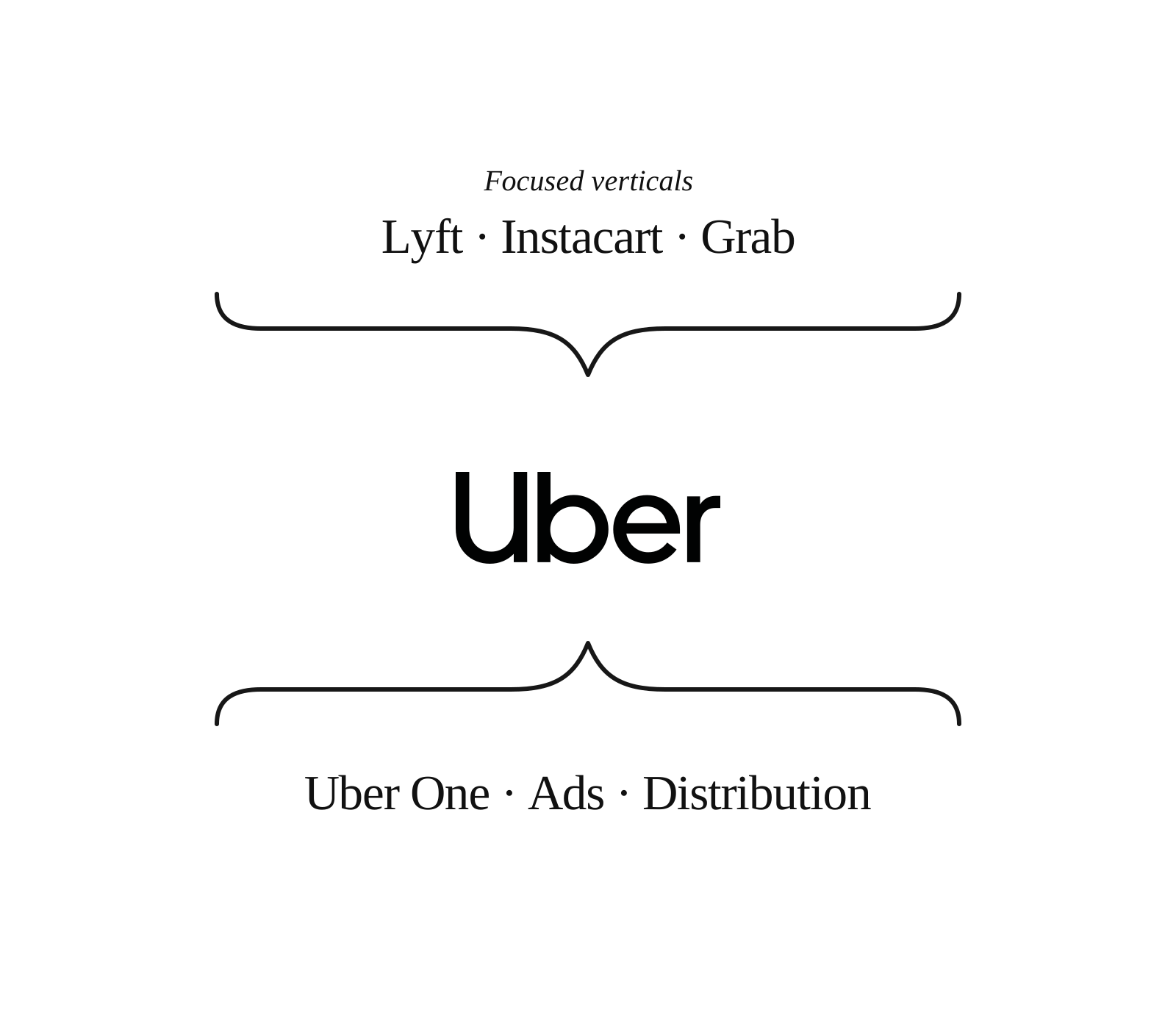
Firstly, lots of discussion on Uber, which I have cleared up in another post: AV and vertically integrated “competitors” are not threats, but rather market size enablers and partners. I predict Tesla and Waymo will be on the Uber Platform as well as have their own D2C. Uber and DoorDash will probably try to bite into each other’s market share, and that would be the incorrect strategic decision. Uber has basically allowed several one-vertical companies such as Lyft, Instacart, Grab, and possibly Wonder Group (When they run out of cash), which they can consolidate and leverage the independent brands to increase growth. The EV/EBITDA scenario below illustrates the acquisition cost using FY2025 adjusted EBITDA. At 12x, Lyft, Instacart and Grab would total roughly $25 billion in enterprise value; at 16–20x, roughly $34–42 billion. These are scenarios, not current offers or transaction prices.

Strategy diagram: Uber connects focused verticals Lyft, Instacart and Grab with Uber One, ads and distribution
EV / EBITDA scenario analysisImplied acquisition enterprise value, $B
Company8x12x16x20x25x
Lyft4.26.38.510.613.2
Instacart (Maplebear)8.713.017.421.727.2
Grab4.06.08.010.012.5
Total16.925.433.942.352.9
EV / EBITDA scenario analysisMarket today (September 9, 2026)
CompanyFY25 Adj. EBITDA ($M)Current EV ($B)Implied multiple
Lyft5295.029.5x
Instacart (Maplebear)1,08710.189.4x
Grab5008.6117.2x
Total2,11623.8111.3x

Adjusted EBITDA as reported for FY2025: Lyft $528.8M, Instacart (Maplebear) $1,087M, Grab $500M (company reports, February 2026). Implied EV = FY2025 adjusted EBITDA x multiple. Current EVs pulled September 9, 2026; implied multiple = current EV / FY25 adj. EBITDA, i.e. what today's price pays. Rough estimates; totals computed on unrounded figures. Wonder Group excluded - no public value.

Rideshare/Delivery only have regional network effects, so they should operate these brands separately and realize the opportunity for these firms to continue to grow their top line. The real opportunity is to connect those brands to Uber’s advertising network and Uber One. Uber reported 50 million Uber One members in the first quarter of 2026, with members generating half of Mobility and Delivery Gross Bookings. An expanded bundle could make the membership more valuable; Uber does not report standalone operating profit from Uber One or its ads business.

Why focused verticals lead to consolidation

Consolidation in this industry is imminent; it is enabled because of a concept I discussed previously -

Focusing on verticals on paper seems like a bad idea, and in the long run, the incumbent tends to eat the share slowly but surely. But there is a short- to mid-term period where focusing on an X market allows for sustainable profits and strong brand affinity. Eventually, the incumbent includes the vertical in their business, and they leverage their scale and greater distribution to take more share in the X vertical. Eventually leading to consolidation of sorts. The reason a focus market succeeds in the short to mid term is that the incumbent cannot focus on every market, and cannot successfully market a product for the X vertical. Hence, it allows for a startup to build a business around that X market and use it as leverage to expand in a land grab. It is this tug-of-war for market share that eventually leads to consolidation, where the incumbent acquires the focus market. Usually, if the company they acquired has a consumer brand, it would be best to leave it operating as itself. Such as Uber’s acquisition of Postmates.

The VC funding in the ridesharing delivery space allowed for the Instacart of the world to reach great heights, while being a focus market. While no guarantee can be made of any of these transactions, Wonder Group acquired Grubhub in 2025, and in July 2026 Uber announced a cash offer for Delivery Hero. The proposed deal spans businesses in 50 markets, not just Germany; it remains subject to conditions and Uber expects it to close in the second half of 2027.

DoorDash’s restaurant software opportunity

DoorDash seems to have an interesting strategic play in all this. Trying to compete with Uber for a greater share in delivery would be difficult and costly; hence their strategic decision to sell restaurant enterprise software and their acquisition of SevenRooms.

While the restaurant technology industry has many players, Toast being an example of the low-end disruptor, DoorDash is a chokepoint for restaurants, as delivery has become an important demand channel for many of them. So surely, over time, DoorDash can consolidate several restaurant enterprise products and bundle them with its delivery and create a fully integrated restaurant management system.

Most companies in the delivery space settle on bolting on additional monetization methods such as a subscription product - UberOne, DashPass, Instacart + etc, and also creating an advertising marketplace. While these are great strategic options, they are heavily influenced by the success of the core business. DoorDash wants to move upmarket, which seems like the natural thing to do, and capture a larger share of what the restaurant industry has to offer.

This strategy will be a slower and more managed strategy, as DoorDash could see regulatory risk if they try to leverage its valuable position in the industry too aggressively against companies like Toast. Of course, they could just try to acquire their way up, which they already have in specific parts of the industry, such as SevenRooms; regulatory risk may prevent them from just going and buying Toast, so the more likely outcome is some kind of partnership/integration where DoorDash gets a fee on the Toast platform, leading to high-margin revenue in the space.

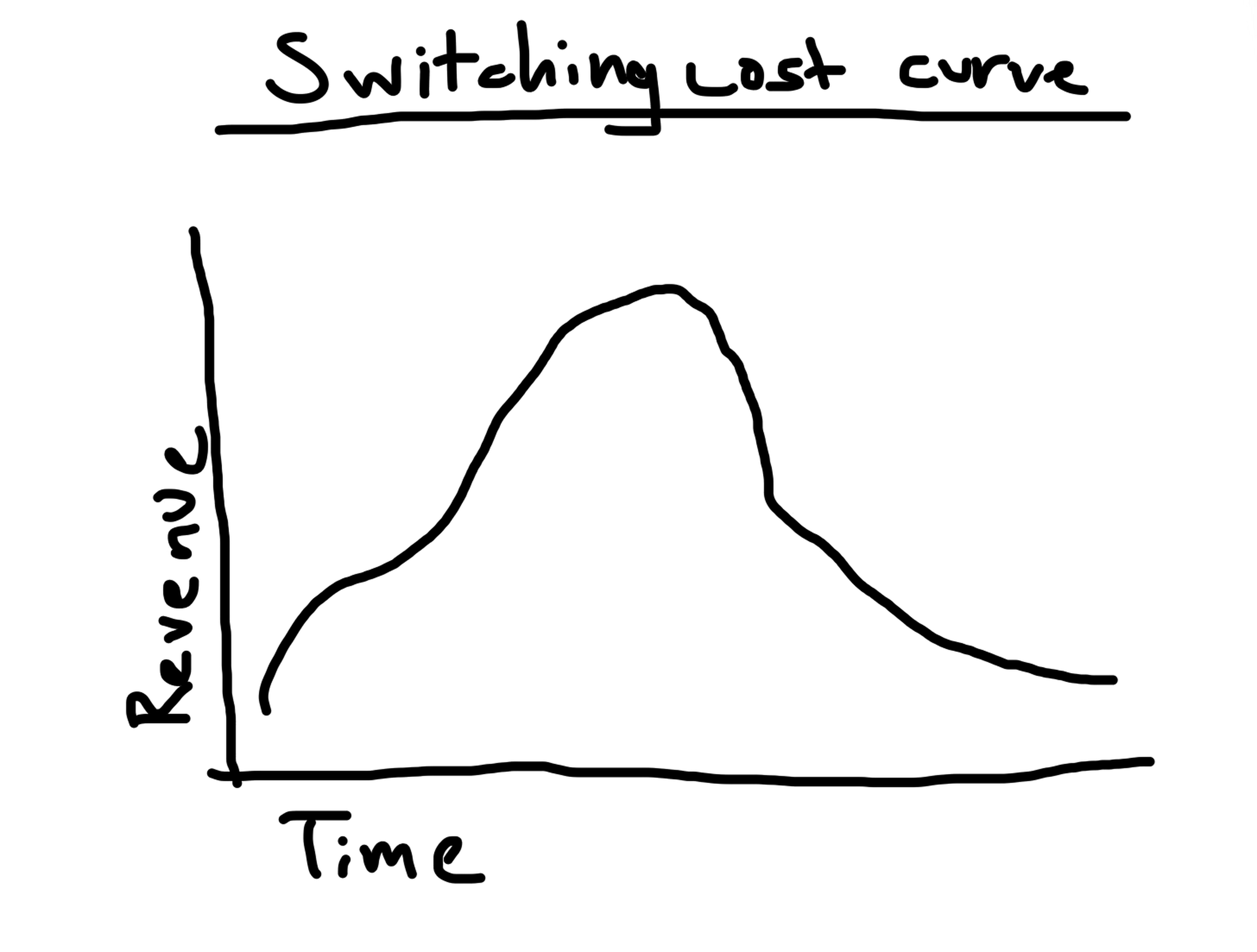
The power of switching costs is unreal, although they do not necessarily grow revenue or increase profits; rather, they just allow a company to maintain what they already have built. An example in the restaurant enterprise space is PAR Technology, which historically sold large physical systems to mid- to large enterprises, and this gave them great cash flows while this was the major technology, but then the transition through the low end of companies like Block and Toast has forced PAR to begin to acquire its way out of the innovator's dilemma.

Hand-drawn switching costs curve: revenue rises then falls over time
M&A & Consolidation

How GE Turned RCA Into a Crown-Jewel Acquisition

GE Acquires RCA - 1985

September 2, 2026

The greatest acquisition ever, which nobody seems to discuss, perhaps because of the oddness of the unrelated markets, or because it has been more than four decades. Though I think the story is interesting and useful for m&a and business model strategy today. Conglomerates are like abstract art in the corporate world The history of RCA started with a joint venture where, ironically, GE owned a 30% stake. Cut short, the government ordered this to be divested, citing monopoly concerns.

NBC inside RCA

Fast forward to the 1980s, and the media industry was becoming less regulated, and Jack Welch was looking to take advantage. RCA had been struggling; with increasing globalization, the dominance of the once-premier technology radio manufacturer was falling away. I honestly believe the great acquisitions are often crown jewels hidden in a conglomerate, hence my passion for conglomerates.

RCA was one of them (Fun Fact: they owned Hertz Rental, which they sold in 1985), and hidden inside was the gem Jack Welch was looking to unlock: NBC, one of the big three broadcasters. The beauty of this deal, from a financial perspective, is that although the acquisition price was about $6.3 billion in cash, because of the depressed and lagging financials of the products business, the great economics of NBC were hidden.

NBC’s cash flows and the Comcast sale

During GE’s 27-year ownership, NBC pulled in roughly $30 billion+ in operational cash flows and hit shows such as Seinfeld.

Then the two-part sale in the early 2010s to Comcast - $6.2 billion in 2011 and $16.7 billion for the remaining 49% in 2013 - for a total of roughly $22.9 billion. Not to mention GE leveraging the content of NBC to create a valuable cable bundle, resulting in even more premium cash flows. Needless to say, the financial result was a masterclass.

NBCUniversalCash paid to GE
ItemYearAmount
Comcast acquires 51%2011$6.2B
Comcast acquires GE’s remaining 49%2013$16.7B
Total direct equity-stake payments-$22.9B
NBCUniversalSeparate items, not in the total above
ItemYearAmount
Pre-closing cash distribution to GE [1]2010~$7.4B
Purchase of certain GE properties [2]2013~$1.4B
NBC operating cash flow over GE ownership (essay estimate)-~$30B+

$22.9B is $6.2B plus $16.7B. The 2010 distribution and the 2013 property purchase are separate transaction-related cash items and are not added to it. The ~$30B+ operating cash flow figure is an estimate from this essay, not a filing figure. Sources: [1] Comcast 2011 Form 10-K, Joint Venture Transaction; [2] Comcast 2013 Form 10-K, Redemption Transaction and property purchases.

Ironically, they bought it in a fire sale and sold it as well, in desperate times, which left significant money on the table, not that they had any choice following the 2008 financial crisis. This leads to this year’s news about NBCUniversal being spun out from Comcast; GE did merge NBC and Vivendi Owned Universal in 2004, and Vivendi retained a 20% stake.

Acquiring hidden crown jewels

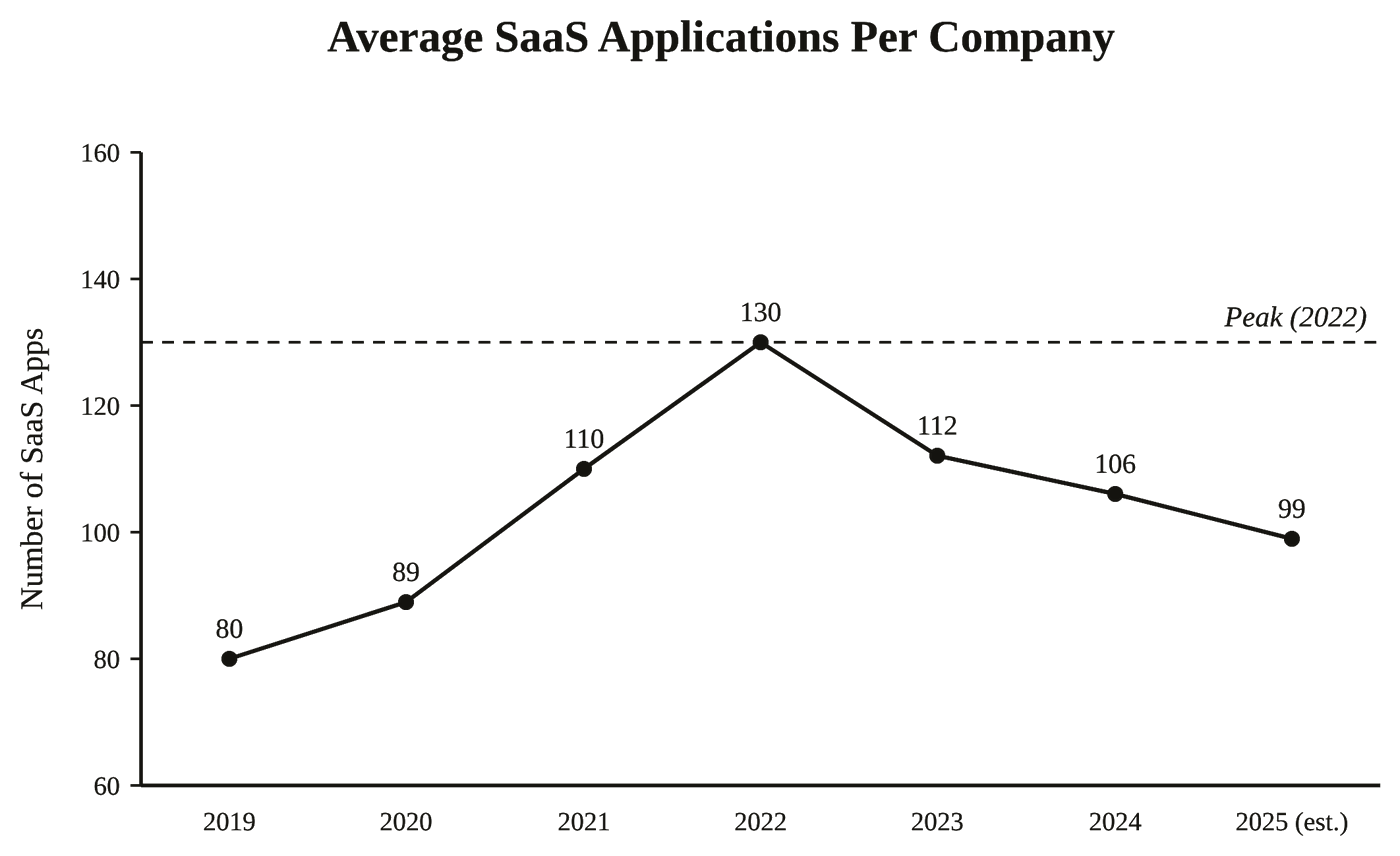
The strategic implications of this deal are interesting, really in that at some point a firm investing in its own capex hits diminishing returns and looks to grow through m&a. Too often they look at what does well today, and overpay. The playbook of acquiring hidden crown jewels is not implemented enough and should be used more in strategic situations. Looking today, different sectors, such as SaaS, are depressed from historic peaks, perhaps justified, yet still undervalued considering the robust switching costs inherent to their nature of the business.

Several opportunities exist to bundle existing single-feature SaaS firms and upsell them through larger firms' extensive product catalogs. Companies like Salesforce, Microsoft, Atlassian, etc should acquire such firms, ex. Dropbox, Notion, Intercom (Fin), and take the existing embedded customers and upsell them, and leverage the structural underlying moat of switching costs, which allow for this. The nature of an asset such as NBC can thrive within a conglomerate because it can behave somewhat like a startup.

Perhaps Stripe stays private for the same reason NBC thrived inside GE: it can leverage the funding and resources of a larger parent without the quarterly pressures Wall Street imposes. It allows for more risk, and often equivalent innovation, with less friction for deals such as the NBC - Universal deal, which combined content with physical assets and pricing power, increasing cash flows, something that may have been opposed had NBC been its own public entity.

Funding new businesses inside a conglomerate

That is why I think more firms should be open to being acquired by conglomerates and not be stubborn, when clearly their future as a public company is difficult because there are great costs to reset and build a truly defensible business; being part of a conglomerate allows for such resets. An example of this internally is Sony and PlayStation. Surely the investment made in PlayStation, the power behind each console, would not have been possible without the balance sheet of Sony and the distribution to compete with Nintendo.

Today PlayStation accounts for 32% of Sony’s operating profit, all from an internally funded project. Conglomerates are like a bunch of ongoing experiments usually funded through one or two major cash cows, and each funding the next, Amazon being a prime example.

Often a single subsidiary drives the profits and funds the future of the business. Another example of this, while this is more speculative, you can see why it can work: many conglomerates own food businesses with extreme brand loyalty that may be depressed for various factors and could be a cash cow hidden on a balance sheet. I am confident these opportunities exist today and should be looked for, specifically in m&a.

GE acquiring RCA was no small feat, at the time the largest non-oil transaction, and selling off any businesses that had overlap with GE had to be mind-boggling for the markets. Great acquisitions often make or break firms; where would Meta be without Instagram, or Disney without ESPN? Conglomerates are interesting to study for this reason exactly; what seems like a garbage heap, if looked at closely, can be gold.

M&A & Consolidation

Why Middle-Market Strategies Get Stuck

Nike, BMW, and others

August 21, 2026

The middle market in strategy is a dead end. Why? Because it tends to be a graveyard of companies with the ability to generate profits but not have great margins, and they tend to die out over time, either through low-end disruption or high-end disruption. Some kind of mix of both, and they get squeezed out. It is important to note they can be decent businesses but often not the most profitable and long-term successful ones. Nike & BMW are good examples; more interesting are the companies they enable.

Nike and BMW in the middle market

Figure 1

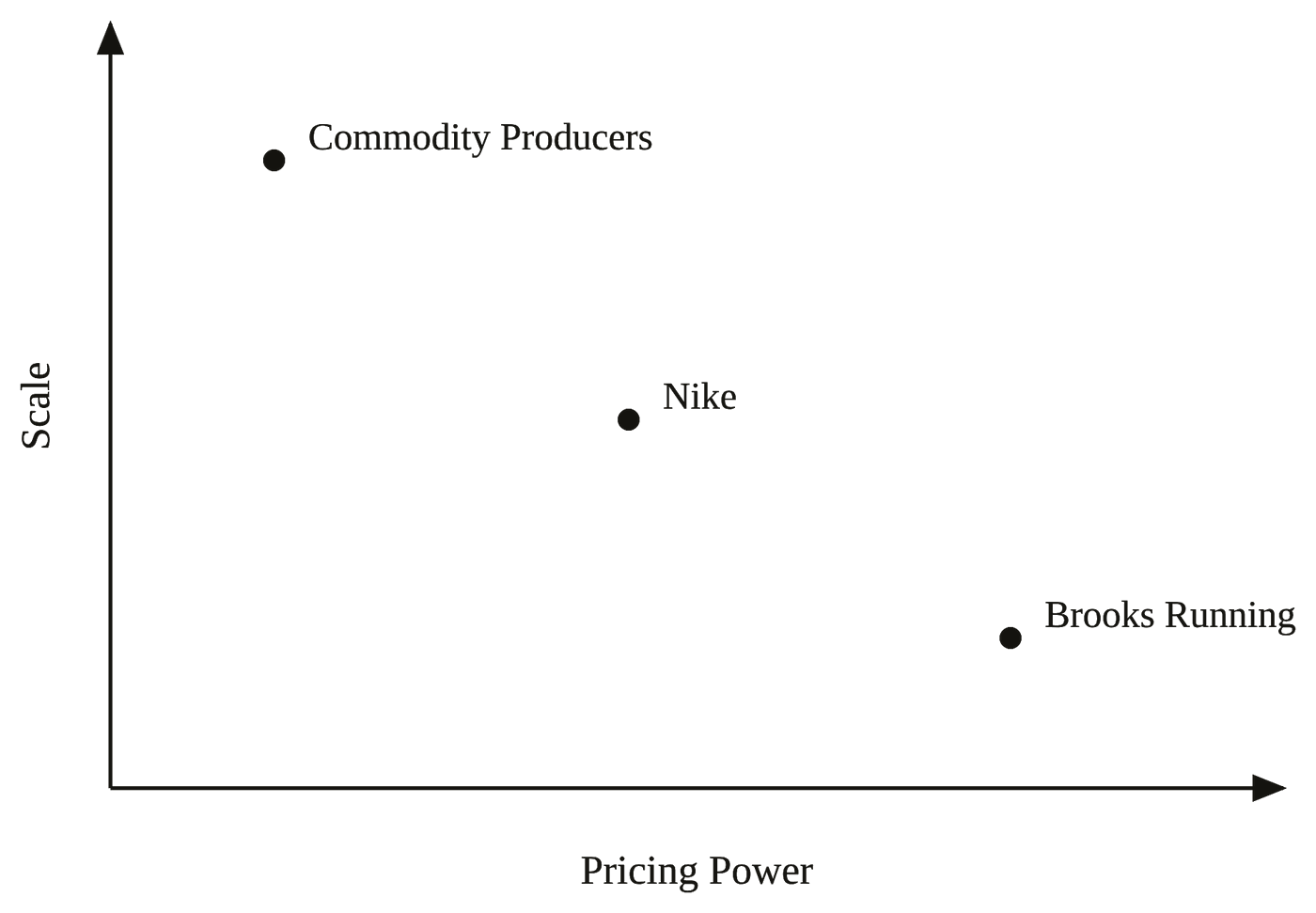
Nike’s core problem is that they have extracted the value and reached a position where they have scale, but still do not price as a commodity; hence, they are not marketspecific, such as Brooks. Making them the largest player in a middle market is not the best achievement. They have a cost structure and extensive marketing, which means they cannot lower their price while at the same time having scale; that cannot allow them to focus specifically on one brand, such as running, as Brooks can.

So both markets eat at Nike’s competitive position, and over time Nike will just be a shell of itself. From a strategy perspective, they would have to create some kind of switching costs around their shoes, or build an official reselling marketplace for their shoes and capture the take rate. Although it may be too late, they can use the fact that the shoes are their brand to create authenticity approval and force sellers and buyers to use Nike.

BMWMarket position
SegmentBrands
HighFerrari, Porsche
MiddleBMW
LowToyota, Honda

BMW is interesting because I think management knows this; hence the interesting monetization through ads in their car, which people understandably disliked but is a risk they should try at least once. I am not totally sure what they should do, but they should not try to release a high-end or low-end competitor; they do not win that way. Some kind of ancillary service, like car wrapping, could be interesting, trying to monetize through expensive ancillary services.

Focused verticals and eventual consolidation

Firm’s strategies are determined based on cycles; of course, neither BMW nor Nike started out as the dominant firm in a middle market. But as you tend to grow and define an industry, new entrants come in and view you as the incumbent, and their strategy is wholly around being counter-positioned to your firm. Brooks Running is a better business because the cash flows are more durable; they are not reliant on foreign markets and consumer cyclicality; rather, they are “Focused” on X market, which allows them to deliver outsized profits.

However, as time goes on, if they are in pursuit of growth, they will have to move downmarket once they saturate their focus vertical. Focusing on verticals on paper seems like a bad idea, and in the long run, the incumbent tends to eat the share slowly but surely. But there is a shortto mid-term period where focusing on an X market allows for sustainable profits and strong brand affinity.

Eventually, the incumbent includes the vertical in their business, and they leverage their scale and greater distribution to take more share in the X vertical. Eventually leading to consolidation of sorts. The reason a focus market succeeds in the short to mid term is that the incumbent cannot focus on every market, and cannot successfully market a product for the X vertical. Hence, it allows for a startup to build a business around that X market and use it as leverage to expand in a land grab.

It is this tug-of-war for market share that eventually leads to consolidation, where the incumbent acquires the focus market. Usually, if the company they acquired has a consumer brand, it would be best to leave it operating as itself. Such as, Uber’s acquisition of Postmates.

AI and the durability of enterprise software

You see this today in enterprise software, with so many startups using the hype behind AI to create enterprise companies that solve x problem using AI. But fundamentally, you can see why they would not work in the long term because most enterprise software has enough customer captivity that there is not a good reason to leave. B. The AI features can easily be bundled in.

If Anthropic’s S-1 comes out and they have great numbers, it does not necessarily mean they have long-term success if, in a couple of years, it becomes clear that, for the cost, the productivity gains are just not enough. It is something difficult to assess; on one hand, growth is unbelievable, but it may be a shortterm arbitrage. I generally think models are commodities, and the frontier labs’ pricing power in the long term will be nowhere near enough to be justified as a software business; rather, some kind of public utility.

I see a lot of the value from AI strengthening existing moats for current companies rather than creating new ones. Anthropic should leverage the temporary arbitrage of cash flows in acquiring companies that have real, durable businesses under the hood; the current valuation drops in SaaS companies that Anthropic has caused are probably the right place to look, considering most are still growing and have incredible switching costs which last much longer than many think.

Fun Fact: IBM had greater revenues than Microsoft all the way up till the early 2010s, far after the market had decided Microsoft was the far better business. Narratives tend to allow for great opportunities in the short term; Stripe pursuing PayPal is such a steal, as they are buying a distressed brand with FCF that is likely on par with Stripe’s revenue as of writing.

Disruption

Why Disney+ Struggles to Monetize Its Content

Disney + & Movie Studios

August 12, 2026
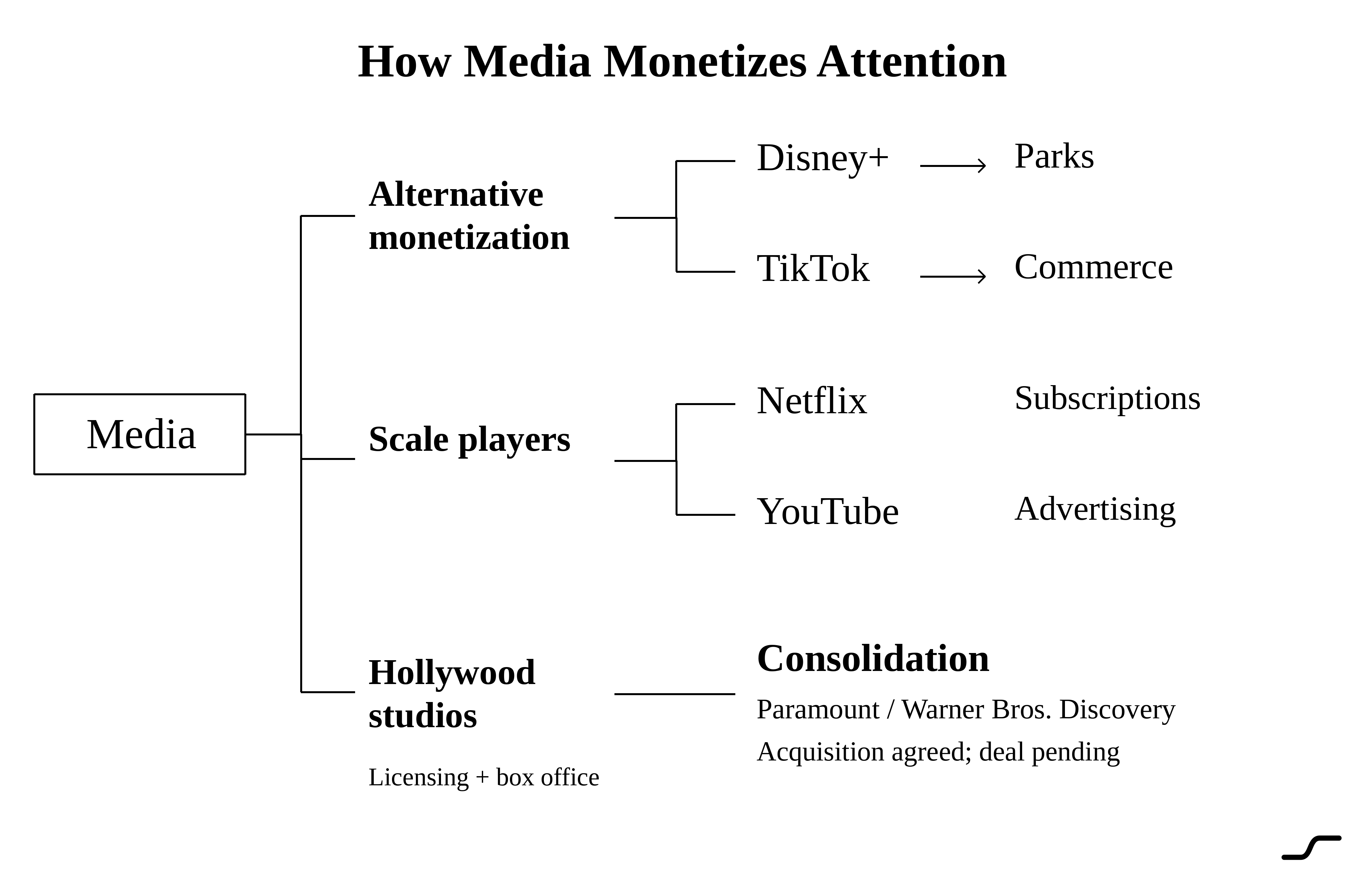
Media market: Disney+ and TikTok monetize through parks and commerce; Netflix and YouTube are scale players; Hollywood studios face consolidation, including the pending Paramount and Warner Bros. Discovery acquisition.
Consolidation: Paramount / WBD agreement (deal pending).

Disney’s content and parks economics

Media is a messy industry, yet the incumbents are going strong in their own ways. The state of the industry is pretty much summed up in the sloppy graphic. Apparently Disney + should have ended Netflix, but by licensing content to Netflix, all the studios locked in Netflix’s scale economies, enabling its position in the middle market. Disney + seems to me like this very expensive, yet unnecessary, failed experiment if we set the bar as unseating Netflix.

But it has seen growth in subscriber count, yet clearly needs to become profitable; it is a case of poor capital allocation. The reason Disney could have continued to license content to Netflix, and be ok is because there profit engine is Parks; the actual content is rather an expensive way to acquire customers and use Parks as a way to extract lifetime value. Their supply was not being commoditized since their unique content still drives consumers to their parks. Instead, they tried to build their own customer relationship, spending billions, only amassing 1/3 of the subscribers Netflix has. Disney would rather help Netflix as much as Netflix would have helped them.

Disney would be able to replace dying cable profits with Netflix’s licensing fees, and Netflix could grow its subscribers and continue adding first-party content. Disney being on Netflix does not stop people from going to parks; Disney’s unique content allows both Netflix and Disney to operate as equals.

Yet the power of Sunk costs is visible, and while Pixar, Marvel, and Lucasfilm could have been justified as furthering the fandom for Disney and their parks, the acquisition of 21rst century fox was a clear content roll-up, which after that they had no choice but to go direct no matter what. Then there is the cost they put into creating additional exclusives to lure more subscribers. All in all, who knows when they will break even on the 21stcentury acquisition and the 11 billion in operating losses due to Disney +.

Hollywood studios and consolidation

But the other Hollywood studios, which also helped entrench Netflix, could not be saved. Once they tried to move into Netflix’s market as well, where economies of scale rule, they miserably failed and will have to undergo painful consolidation; their failure to move beyond just making box office hits has led them to this day. Although it will be interesting to see how regulation plays a role in that.

So perhaps in the future there are a few large streaming giants, with Netflix poised at the top and studios building a hybrid model, nonethless they will make most of their profits through licensing, and will either need to consolidate to survive or become part of an insulated conglomerate.

YouTube, TikTok and different ways to monetize attention

Netflix is overreacting to the threat it sees from YouTube. They have undergone a rapid consolidation of many media forms in an all-in-one-place strategy.

While it may prove correct, it will not hurt YouTube, and YouTube itself is not an existential threat to Netflix. Because YouTube cannot go upmarket in streaming. For two reasons: firstly, that would create friction with their existing free supply of content, which is much better and capital-light; secondly, YouTube will likely not get the attention it deserves as a business from Alphabet, considering they cannot fight an expensive media content war amidst the capex spent on AI.

A YouTube spin-off could be highly value-unlocking for all parties. Netflix’s attempt to aggregate more users by bringing more diversified content could work, but it is unclear how many more people who are not subscribers today will become subscribers if their favorite podcast ends up on the platform. TikTok faces battles for ad dollars from YouTube and Instagram, and wisely has been able to find another place for growth, which is e-commerce, with an in-app native experience, which somehow Meta and Alphabet failed to do.

Obviously, the Chinese roots helped, but it just seems like a missed opportunity for the dominant U.S social networks. The US TikTok Shop reached sales of close to 16 billion in 2025, growing over 20% yoy. So TikTok is insulated from threats from YouTube and Meta. Meta captures high-margin ad dollars on specific first-party user data; YouTube monetizes through ads by leveraging the internet’s premier place for free third-party content of virtually any kind.

The future of studios and streaming

So do we even get cinema releases a decade from now? Undoubtedly so; the guaranteed hits will always be big box office hits, but for legacy studios, you either consolidate or die. Netflix will largely dominate streaming, as they continue to add more content to expand growth.

Disney's corporate focus should be on making great IP that drives fans to their parks for generations, not trying to compete in markets where they are structurally disadvantaged. A key idea is that if you can aggregate attention but can't monetize it as well as others, you have to innovate and drive the attention to other channels for better Monetization, such as Disney with parks and TikTok with e-commerce.

Disruption

Uber in an Autonomous-Vehicle Future

There is a major debate around Uber as of late, on one hand from many valuation perspectives that it is undervalued, and the bear case being this is for good reason, centrally that in a world of AV’s you need to be vertically integrated.

August 8, 2026

Uber’s customer acquisition and monetization

First, it is important to understand why Uber has worked. Mobile has allowed the wave of apps such as Uber to thrive. When you think of ridesharing in a vacuum, Uber and Lyft do not have differentiation among each other; yeah, the boom of the ZIRP period led to capital as a weapon in startups, and to an extent, simplistically, Uber spent more than Lyft on CAC on both sides, and simply edged out Lyft. After that, a great CEO, Dara Khosrowshahi, has created a brilliant strategy for Uber today.

Figure 1

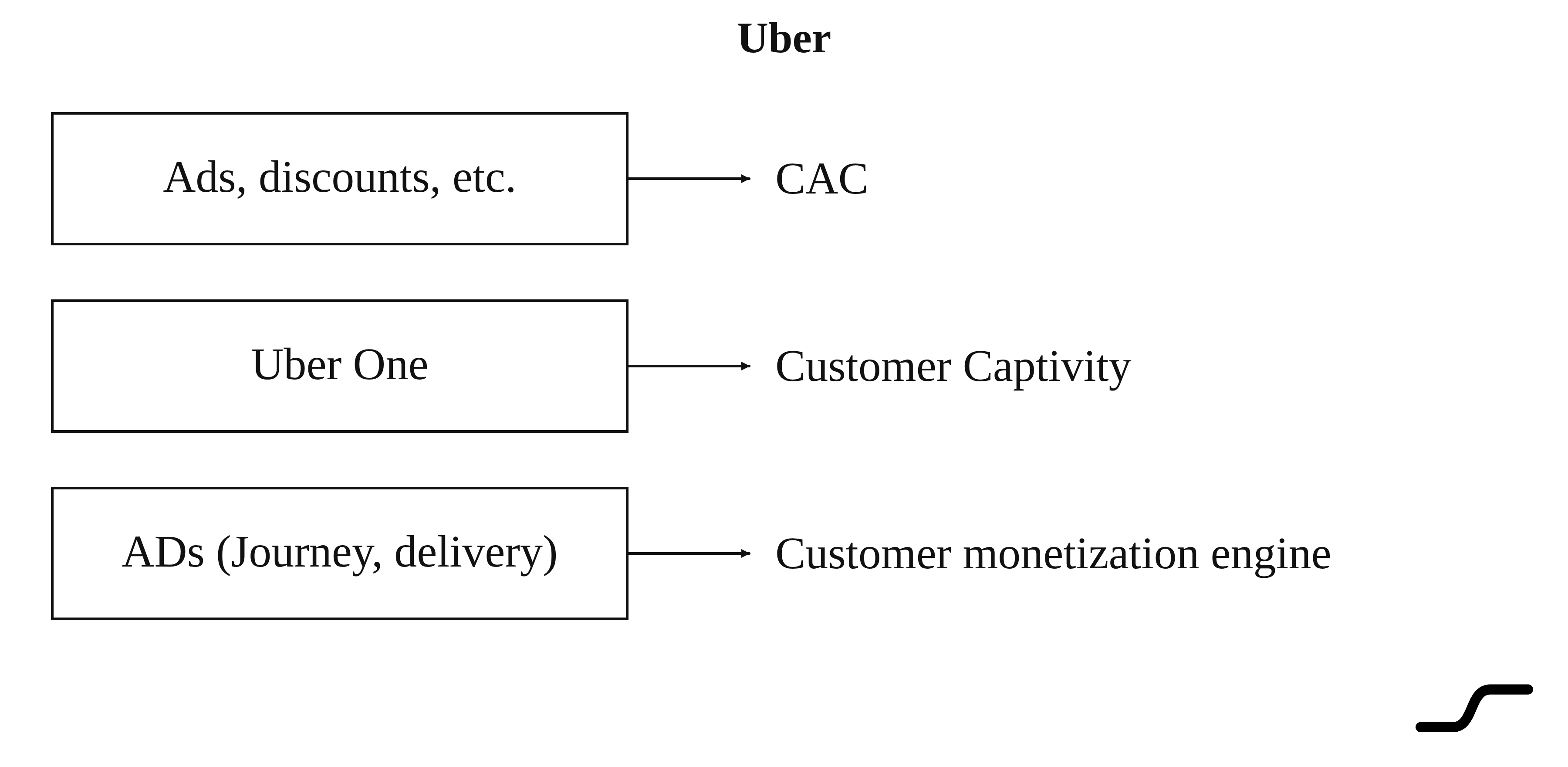
Uber spends the most to acquire customers and drivers, uses Uber One to create customer loyalty, and monetizes through ads. It is truly a brilliant strategy funnel, built on the aggregation of ridesharing and delivery customers and drivers.

Autonomous vehicles and Uber’s platform

The market thinks vertical integration will kill Uber. How so, well Waymo does not need to aggregate drivers since they own the supply of vehicles, this a capital intensive business from the get go. For Waymo to disrupt Uber they would need to create their own DTC model and bring enough network liquidity everywhere so that people choose it over to Uber.

Considering Uber has a decade headstart on the job, currently Waymo is on Uber itself and so will many other AV companies, with a plethora of funding in the space it does seem Uber is positioned to become a aggregator of all ridesharing, while this may mean they stop taking margin on the rides they serve themsevles and just become a platform for the AV companies, considering the original ridesharing business with drivers will decline over time, as AV options will be a fraction of the cost.

If anything this is much more of a disruption problem for car manufacturers, while they surley are not going extinct, the profit margin will continue to shrink, as a few firms eg. Waymo will buy cars shifting the leverage in their favor. I think Waymo can attempt to build it’s own customer relationship, but they would be foolish to not be on Uber, because if they do not there competition will, hence forcing Waymo to stay on Uber.

Regardless the AV layer seems to have the makings of a commodity business, and Uber the middlemen should capture the majority value, and see growth in the business. So it was the correct strategic decison to exit that business considering the capital intensivity, which would lower margins, and the fact there is no clear differentiation or barrier. Here are some numbers on how their topline can grow.

The key metric to watch here is how much GBV grows based on the potential the AV ridesharing market posses, since based on that we can assume what % of revenue is ads, and predict growth in the ads business considering it is what drives fcf growth. The AV ridesharing market is expected to grow between 70 - 100% CAGR through the early 2030s, somewhere between a 150 - 200 billion market. Clearly a oppurtunity for Uber to continue to expand growth and embrace the aggreagtor role. While as a platform with large companies such as Waymo, they will be forced to lower their effective take rate, further showcasing the key monetization engine of ads on top of the actual business.

Capital Cycles

Bending Spoons and the Capital Cycle

Learning about history's great capital allocators makes me wonder who will be the great allocators of the future.

August 5, 2026

Learning about history's great capital allocators makes me wonder who will be the great allocators of the future. The gentlemen at Bending Spoons are not a bad shout. Not because of the specific acquisitions they make, but rather their broader strategy. Silicon Valley has a bad habit of moving on too quickly after a company gets the “irreversible” down round. Yet it is the venture capital and there short term thinking that makes it inevitable for the likes of an Airtable to go from 11 billion to a measly 2 billion (EV).

An orangutan could tell you that Airtable is not worth 11 billion, not today and not in 2021; too bad orangutans can’t network. Broadly though, Bending Spoons is capitalizing on the low part of the capital cycle, post-asset prices falling, after the ZIRP era ended. Ironically, in the valley, one cycle does not end, but another one begins. Silicon Valley moves fast. There are a plethora of zombie startups that fundamentally are worth less than the price tag they were awarded, and Bending Spoons is going on a shopping spree. They are consolidating businesses at discounts to their fair value, and are reviving old brands that still have some consumer relevance.

Enterprise companies that still have customer loyalty and are upselling them to grow FCF. They are wise to ignore the hype of the current AI capital cycle; while everyone is focused on another hype train, Bending Spoons is doing what every good capital allocator does: take what the market gives them and become creative.

Take Cook, for example: realizing that the cash the iPhone threw off needed a place to go, he gave it back to shareholders and compounded value, and built a services business which has created double-sided customer lock-in. Airtable is a clear fable on the risk growth stage investing poses. Early stage may have more risk in the short term, but in the long term, practically any viable exit can deliver >1 DPI.

Growth stage not so much, as seen with Softbank and other late-stage investors; investing at the peak of a capital cycle is just blatantly dumb. This ZIRP era has funded new capital into venture and has permanently altered the structure of venture; most companies will stay private too long, the capital cycle will lead to asset prices falling and major down rounds. Had they gone public earlier in the cycle, there is pressure on management to build a real business; that pressure does not exist in the private markets.

Perhaps this is the main advantage of the public markets. The ROFR clause will never allow any kind of activist investor to force founders to build something real. Investors then mark down the value eventually, and this hurts DPI. Not that anyone cares about that in the current environment. This is why capital cycle investing is so appealing: it is a play on human nature, inevitability, and patience.

Capital Cycles

OpenAI’s Consumer Opportunity and Management Struggle

OpenAI has a unique consumer opportunity.

August 4, 2026

OpenAI is a deeply mismanaged company. Most recently, a blog post that feels like it has got to have dozens of PR violations, responding to the Apple lawsuit. More broadly, OpenAI’s main problem is that it does not have a real competitive advantage. No real models do; the real differentiation is price; they will become commodities.

Consumer hardware as a route to differentiation

The need to move upwards in the market in enterprise software is difficult since the current stack should remain the same, since sticking with Salesforce plus its new AI features is much simpler than the cost of switching to an AI-first startup version, which won’t be around 3 to 5 years from now. So consumer hardware and trying to become the next Apple could work, except you would likely have to focus on people not in the Apple ecosystem because of the double-sided lock-in Apple has. The opposite dynamic works in consumer and mobile, really. Apple with AI is a much worse experience than something AI-first built from the ground up. Especially considering the consumer market does not have the switching costs enterprise does. So clearly OpenAI has some kind of opportunity to be a disruptor, just not to Apple, likely a large chunk of Android users, based on what their new device is.

So while at first it may look like OpenAI is doing too much, it is a desperate attempt to create some kind of real, defensible business, and show some proof of such before they IPO. If they do not do so, public market investors will cut their throats, and they will see a valuation drop like no other, regardless of where we are in the capital cycle.

If they delay IPO plans, it will become clear they are in shambles. They are far behind in the enterprise game, which is short-term anyway. Their best bet is hardware; credit to Altman and co for realizing this, although Apple is a roadblock, which I hope, for the sake of competition, is removed. Hardware is interesting, and perhaps somewhat disruptable towards Apple since OpenAI would be vertically integrated in a way Apple cannot since they do not have their own models.

Execution risk and the cost of building hardware

The difficulty is whether the burn OpenAI is spending on multiple fronts can be sustained long enough to see some promise. No doubt the consumer app is big, in terms of users, yet there is not enough activity to create a large ad business. The reason for this is Google and AI overviews, which are a far better user experience. So perhaps consumers can be an expensive customer acquisition cost to jumpstart the hardware business in some way?

Anthropic and enterprise model economics

Regardless, OpenAI does have the right strategy in terms of attempting to create something defensible and long-term. Now, Anthropic having a more coherent strategy in the short term of focusing on enterprise from the start is better; it is still not defensible. Perhaps because of the fact that the cost of paying Anthropic is far too great and outweighs any form of customer captivity.

Plus, an enterprise gets maximum leverage by training a model, ideally a cheap one, on its own data so it can get insights tailored to the enterprise specifically, something Anthropic cannot deliver. Anthropic’s fall will likely be in line with the broader capital cycle. All in all, both companies as it stands today are massively overvalued, even Anthropic with its sky-high revenue, which is not real considering the capital cycle and short-term interest/desperation of enterprises, especially when there is a less expensive, far more valuable way to implement AI through using open-source models and training them on your data. Application layer companies such as BaseTen and OpenRouter should benefit from building on top of these new commodities. OpenAI, as of now, has the only longterm viable strategy, which has a lot of execution risk, yet excites me about the future of OpenAI.

M&A & Consolidation

Stripe as a Technology Consolidator

I think Stripe’s internal strategy is a consolidation of products within its sector.

August 1, 2026

The influx of many enterprise companies was due to the advent from on premise computing/storage to the cloud, lowering the barrier to creating new companies. Hence, it was somewhat possible to create “Niche” enterprise businesses, such as a Dropbox or an Intercom. These businesses were able to create sustainable recurring profits because of a business model boom and customer captivity in terms of enterprise switching costs.

Hence, none of these businesses are disappearing and should remain stable companies for a long time. There is a broader move to add company-adjacent products to further entrench customers and somewhat diversify from a core business. As costs rise for enterprises via AI spending, there is a need to cut costs and not pay for 20 different niche enterprise solutions. So there is a market need for a more bundled experience. Stripe has launched several products around the core payments business to help with accounting, taxes, and incorporation. Cloudflare is doing something similar by creating a suite of cybersecurity products, all under one roof, VPN’s, boxes, CDN’s.

This broader repeated concept of new technology leads to fragmented markets, then slower growth, and a need to expand the core business to continue to grow and expand their respective businesses. So this is further strengthened by the recent acquisition efforts Stripe has made in PayPal and OpenRouter. PayPal is interesting because it gives Stripe a powerful brand and acceptability in payments on the internet. It also gives Stripe an entry into the consumer market and p2p payments.

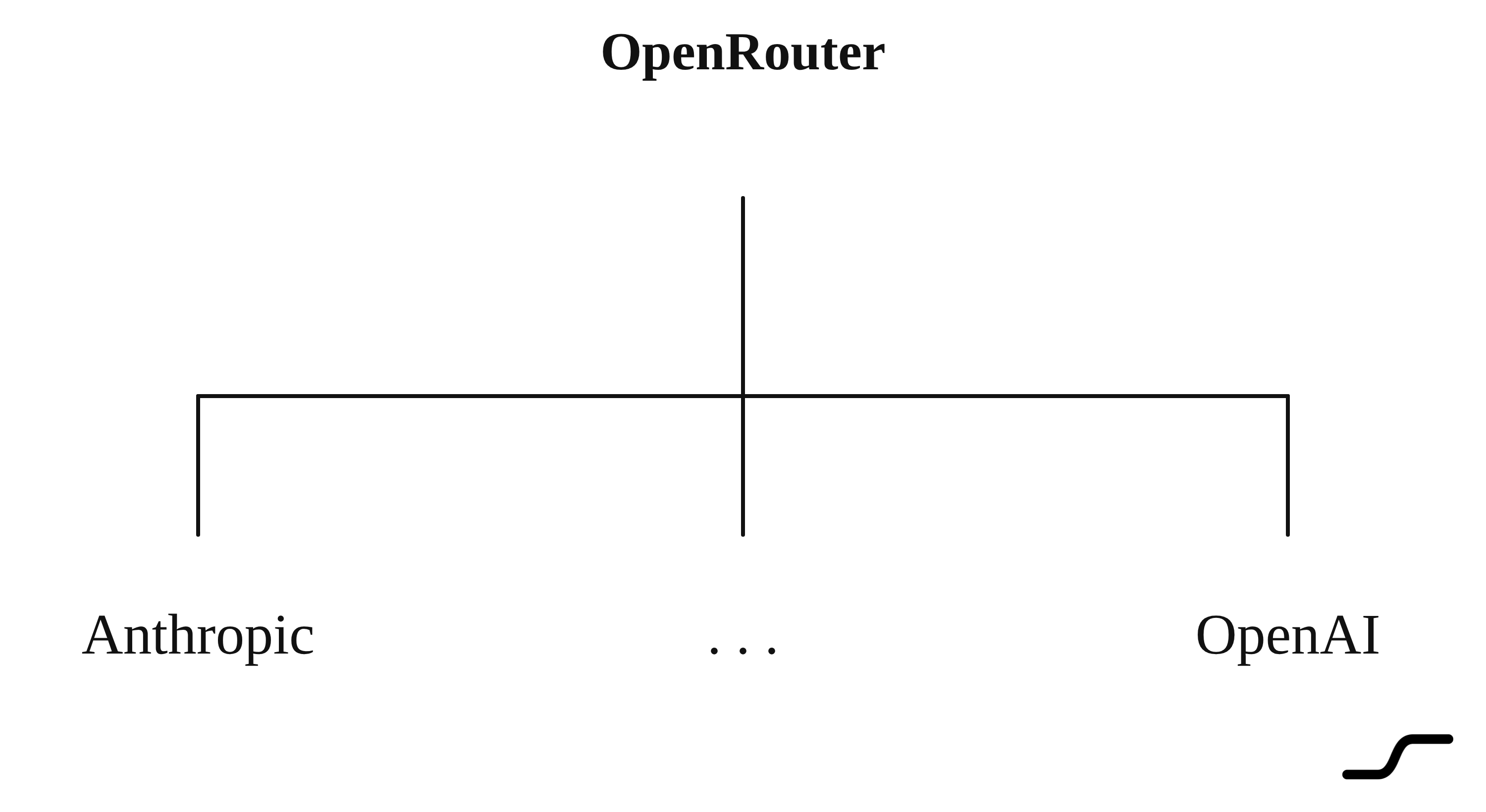
OpenRouter is more interesting because of its potential position in the AI value chain. There still does not seem to be any kind of economic barrier protecting frontier models from an inevitable commoditization. OpenRouter acts as an aggregator of sorts, and could be the premier application in the AI value chain. While both are still under negotiation, it highlights the broader strategy of building a suite of products.

This creates a much more valuable business because the likelihood of growing and defensible cash flows increases. You can switch, perhaps all your files on your Dropbox to a GDrive, difficult but not unreasonable. You likely cannot switch your payments, your taxes, your accounting, and additional products. Overall consolidation is just a natural phase in the industry, and perhaps the most value accruable to shareholders.

It is the strategy of investing based on capital cycles and an interesting development in the current state of enterprise SaaS. The current new wave of companies building AI first is likely to not stick around. New technologies are almost always better bundled in the enterprise world. Figma is a much more enhanced product with AI, not irrelevant. Though to build defensibility, you cannot just be a one-trick pony; surely companies that are really just a feature will struggle as this wave of fragmented SaaS comes to an end. *Credit SaaSMag

Figure 1
Moats & Pricing Power

Why Apple Has the Lowest Disruption Risk

Why has Apple stuck around?

July 30, 2026

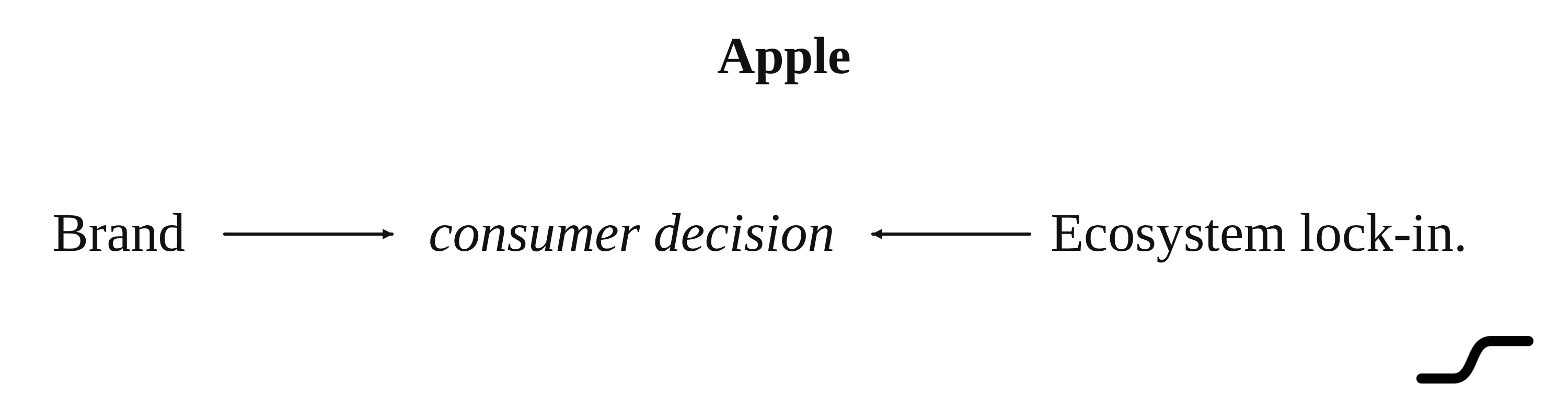
Premium brand, yeah yeah. Except a brand that controls the entire experience has a social contract with society for what its brand represents. Apple has consumer brand willingness to pay, which translates into pricing power, which is why 80%+ of profits in the smartphone industry accrue to Apple. Plus the ecosystem lock-in, on the other hand. They have two kinds of switching costs. So regardless of the new hardware paradigm, consumers have to stay with Apple. Apple is the most valuable technology company because it faces the lowest disruption risk.

Figure 1

So Apple is a technology company, and the most valuable company in the world as of now. How so? Well, the market cares about the future free cash flows a firm can produce, and the certainty and growth of the cash flows. There is great uncertainty about the current technology investment on which I write here. Apple is not investing in capex the same way Meta, Microsoft, and the other major tech firms are. In the short term, this has done well for the firm’s market value.

The key idea is to understand whether this materially hurt the company in the long run. Apple’s central business model relies on creating premium hardware, with the software best enabled for the vertically integrated hardware. They have a brand that delivers this promise.

Apple Inc.Net sales by category (in millions)
Category202520242023
iPhone$209,586$201,183$200,583
Mac33,70829,98429,357
iPad28,02326,69428,300
Wearables, Home and Accessories35,68637,00539,845
Services (1)109,15896,16985,200
Total net sales$416,161$391,035$383,285
Apple Inc.Net sales change
Category2025 change2024 change
iPhone4%- %
Mac12%2%
iPad5%(6)%
Wearables, Home and Accessories(4)%(7)%
Services (1)14%13%
Total net sales6%2%

Clearly, the iPhone is the hardware cash cow; one might wonder what the future is, perhaps glasses? headsets? Regardless, Apple does not have to be the first; rather, it should not try to be. The first mover advantage in hardware is much more of a liability than in software. Regardless of the next paradigm, the brand Apple has created protects it from disruption, as whatever hardware product it releases, most consumers will purchase it, and developers will create applications for it, almost a engrained network effect.

Apple is unique because it is able to have two high-margin businesses, where usually if a company does have more than one, such as Amazon, one typically sacrifices margin for one business, eg food delivery, to create a high-margin profit center such as an advertising business. Apple has the luxury to charge a high margin on its hardware, as well as layer on additional subscription businesses, which creates customer lock-in.

So, from a strategic perspective, Apple is likely being valued or should be valued in a perspective of low disruption, compared to its peers. It is difficult to see another consumer technology company with the double-sided lock-in Apple has and should continue to have in the future. Despite that, regulation always does lead to the fall of such giants; the app store economics, the vertical integration, and pricing out competition could all lead to some kind of antitrust scrutiny.

Capital Cycles

The Capital Cycle: Fiber Then, Data Centers Now

Fiber in the 90s, Data Centers today.

July 26, 2026

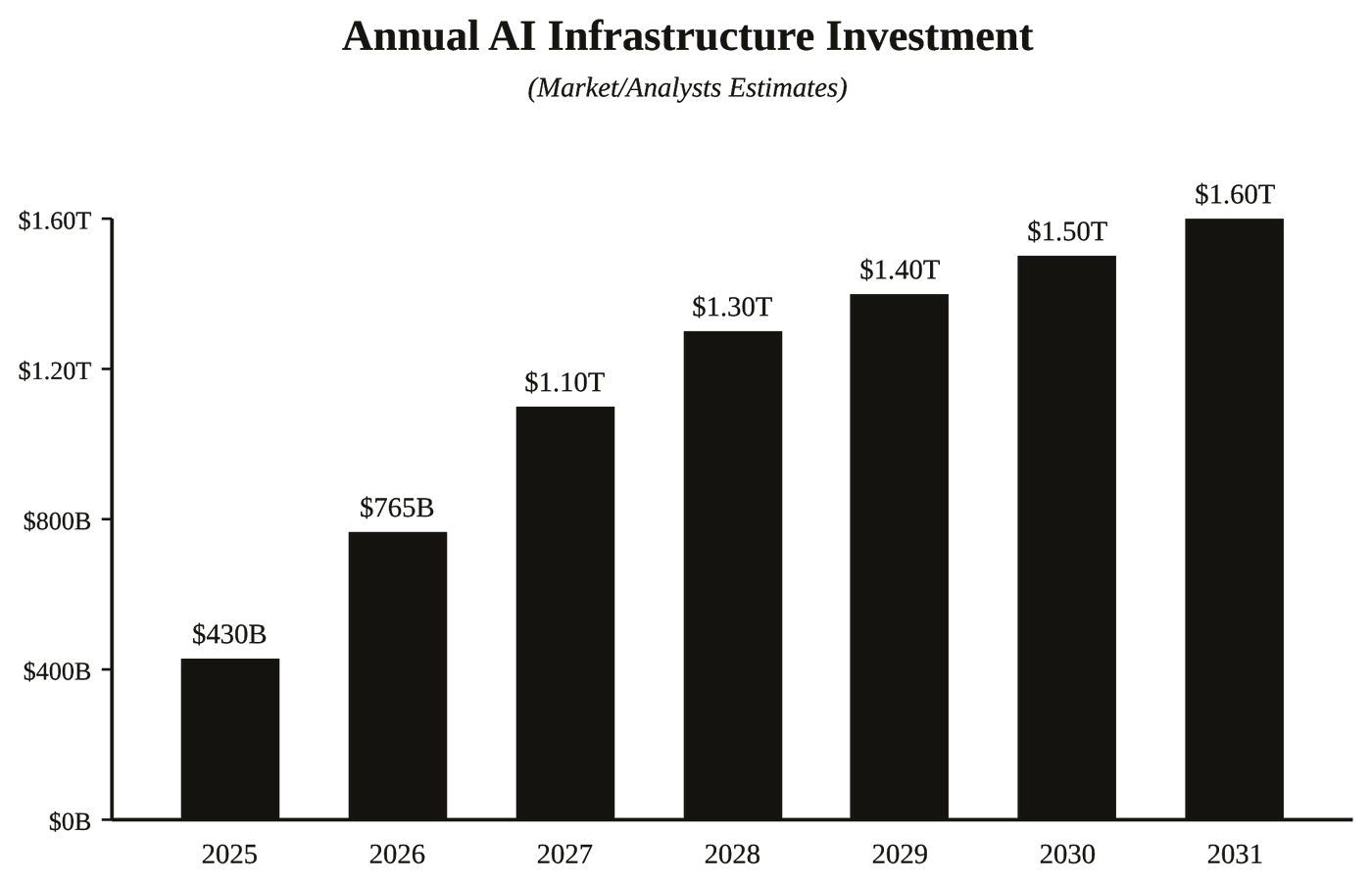
History rhymes or repeats, who cares? The capital cycle theory is simplistic and just wonderful. It is also common sense. Created by Marathon Asset Management, it simply explains a cycle. Where there is an asset that is underinvested, leading to successful investment and corresponding successful returns. Then the world finds out, and the asset becomes overinvested, and returns fall, and so the asset becomes unattractive. And so the cycle repeats. Today's hyper-investment in data centers for “AI,” which means many things, is led by the major tech firms (Google, Microsoft, Amazon, Meta, etc). Here are the numbers -

Figure 1

Fiber investment and the data center cycle

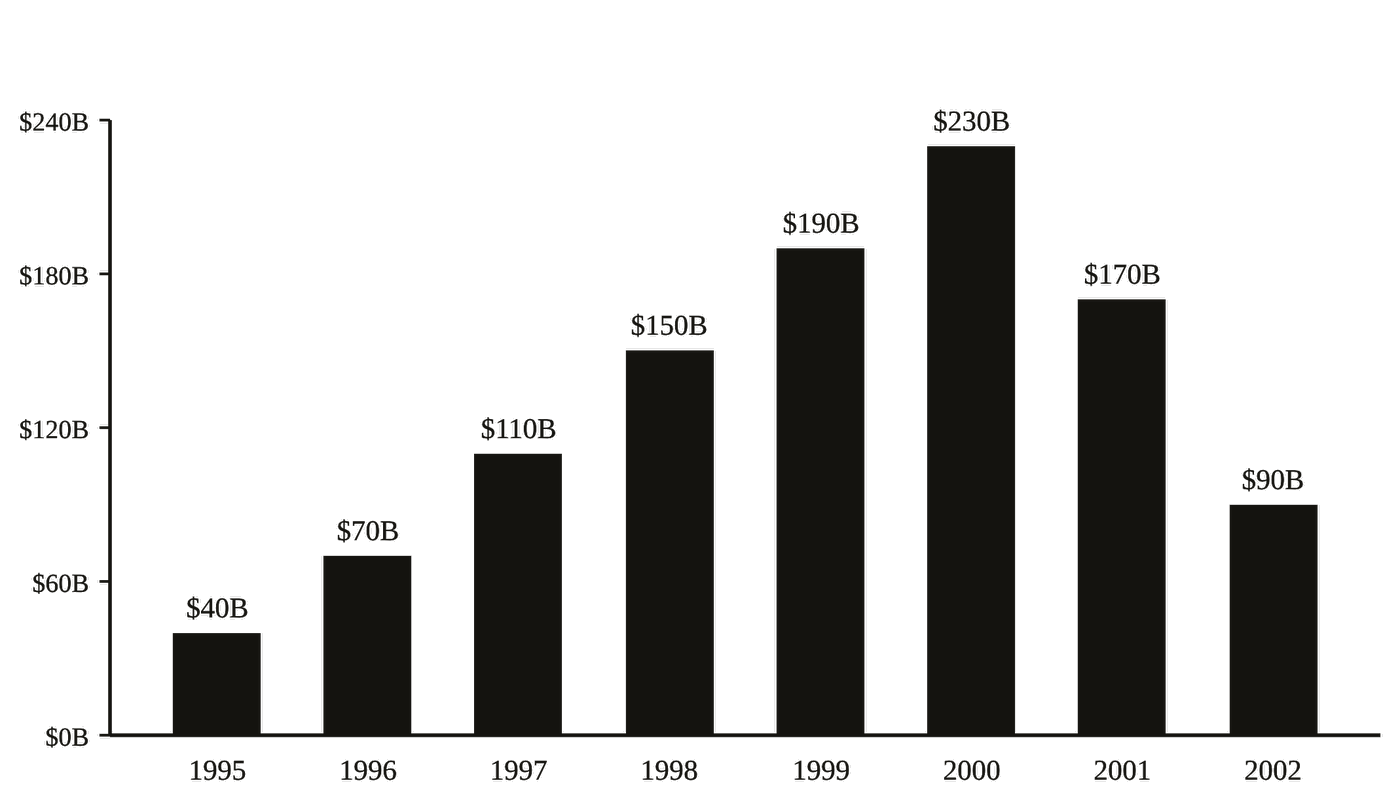
Now observe investment spend during the 90s, in fiber-optic cable, for the internet -

Figure 2

When comparing spend size, it makes sense to look at spend as a share of GDP. Fiber and telecom investment peaked at about 1.2% of GDP in 2000. By comparison, capex by the five largest U.S. tech firms for AI infrastructure was about 1.2% of GDP in 2025 ($380 billion), with 2026 guidance at about 2.4%. Yet we do not know how much longer the current investment cycle will last. Similar to how in the early 90s, companies such as MFS and Nortel generated excess returns and laid the groundwork, then major investment funded by debt from companies such as WorldCom led to overcapacity and the asset bubble, and the returns fell.

Similarly, the early success of AWS has proved data centers as a great asset, which has brought great returns for the likes of Amazon and Microsoft. Now we see many more players building for AI specifically, although the underlying idea of a data center is largely the same. And if the capital cycle theory proves correct, then the overcapacity should be realized and returns fall. A common counterargument is the revenue backlog for these companies.

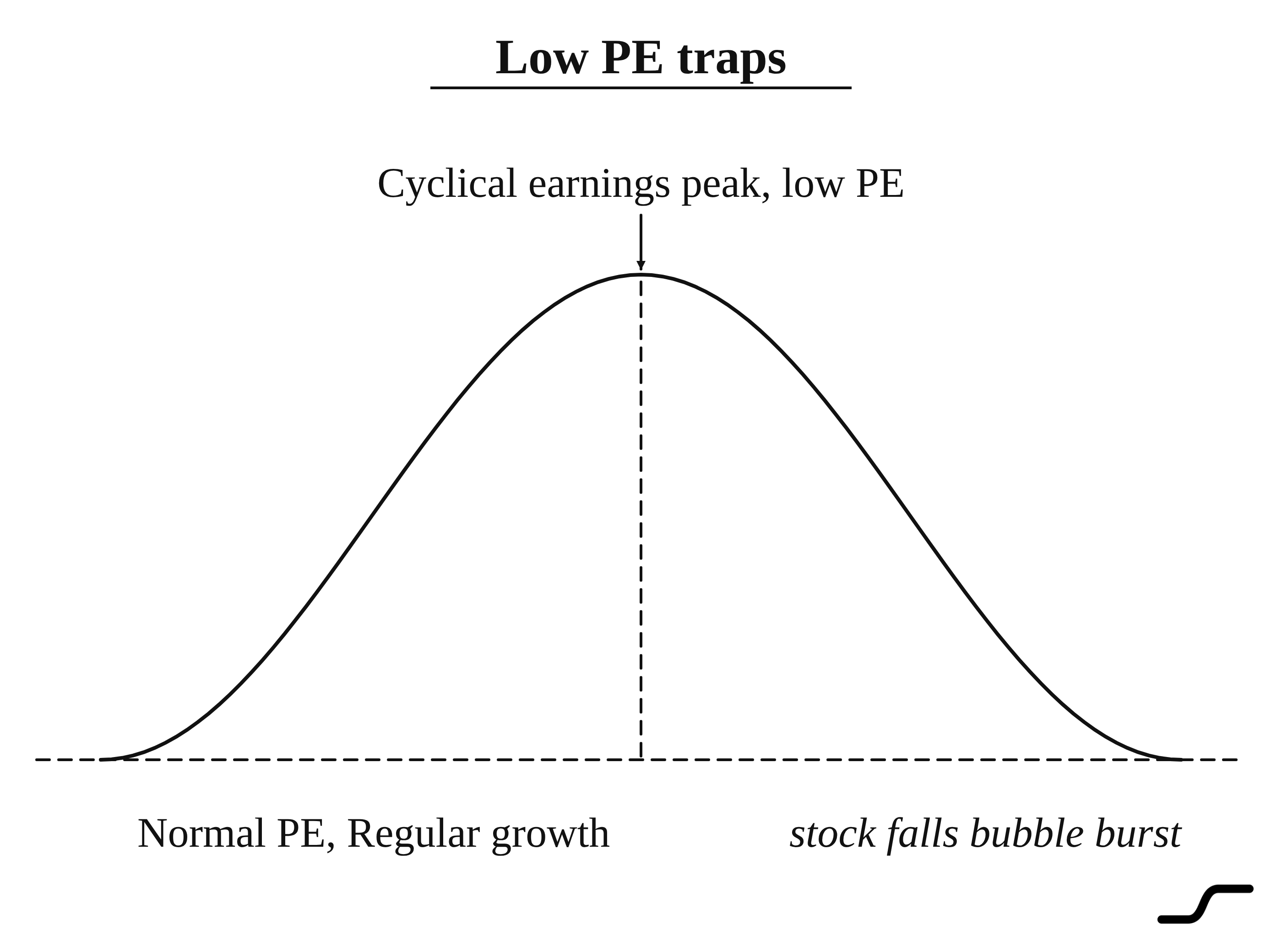
The same argument was made during the fiber optic bubble; similar massive backlogs existed, and then they did not. Once there is clear overproduction, the entire value chain collapses, and along with it, so do the backlog commitments. This overlaps with the idea that low price-to-earnings ratios for equities are a sign of an asset bubble, since at the height, earnings are inflated, yet unsustainable nonetheless. Similarly, the same problem exists in venture capital with the capital cycle theory.

The same cycle in venture capital

Once a certain industry produces great exits and high DPI events, more venture firms decide to invest; some create industry-specific funds, driving up prices across every series of funding. This hurts more in growth equity, while early-stage investing can deal with a price increase because they invest so early; their returns are still high at an exit. Growth equity often pays too high a price, and eventually the company faces a down round, and fund managers have to mark down valuations.

The returns required from AI infrastructure

Thus the industry becomes unattractive, and returns are found elsewhere. So, if the capital cycle theory is correct, this spending on AI infrastructure should be overbuilt; then there won't be enough demand to justify the cost of this infrastructure, asset prices fall, and we return to reality. Doing some rough math, what kind of returns would these tech companies need?

Likely what their current ROIC is or more; anything less is value-destructive. The blended ROIC of Meta, Google, Amazon, and Microsoft is around 22%. They are spending a combined near 700 billion in capex, and would need close to 160 billion in operating profit to maintain the current ROIC. So is there enough enterprise demand to meet this, especially when models are clearly a commodity business as I describe here?

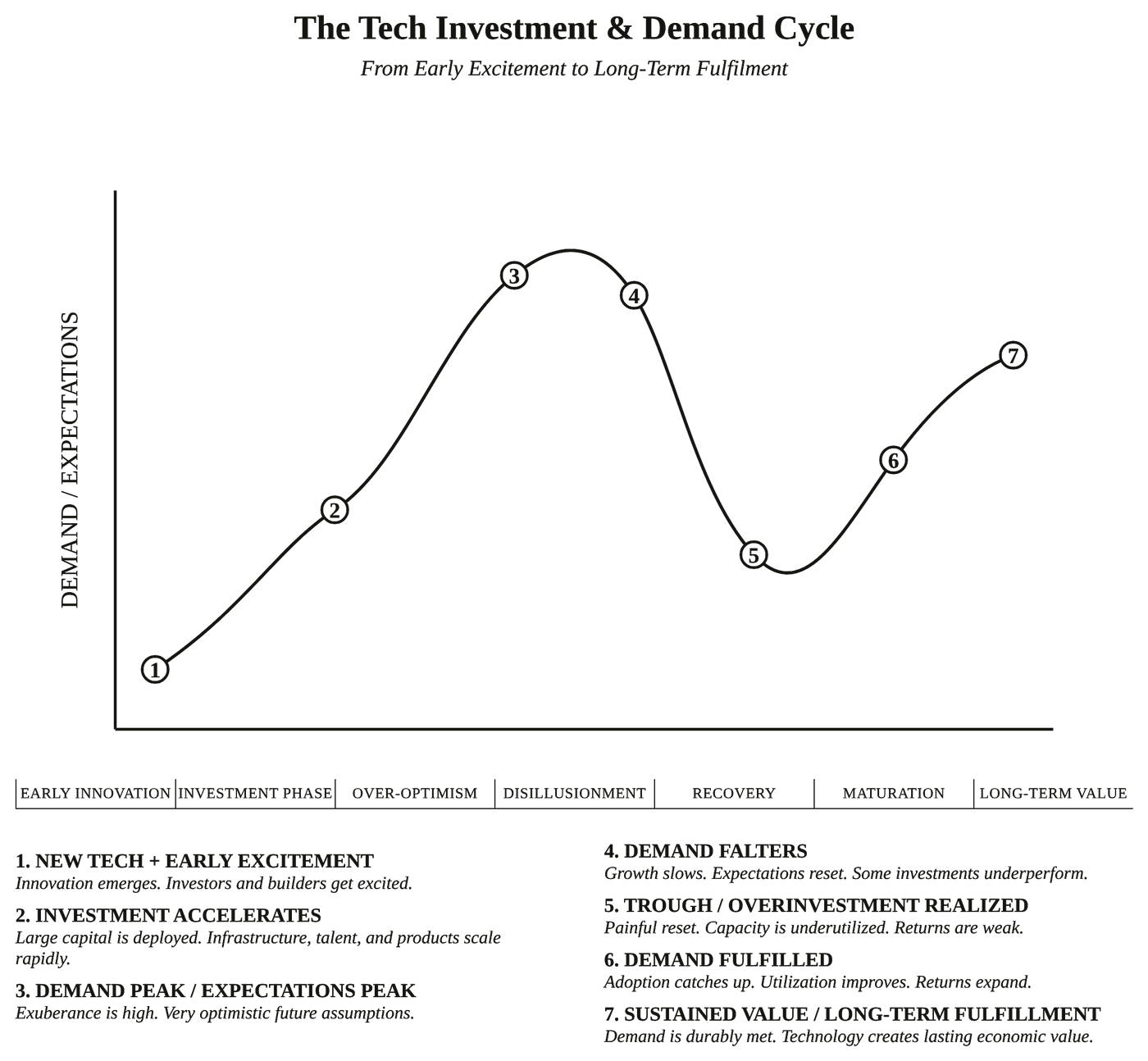
So based on the capital cycle theory, while long-term profits can surely hit the rough estimates, in the short term firms will overbuild based on early profits and see asset prices fall. Around this low is the prime time to invest, considering lower valuations and consolidation should lead to outsized returns.

Figure 3

Sources

https://www.goldmansachs.com/insights/articles/tracking-trillions-the-assumptions-shaping-scale-of-the-ai-build-out

Disruption

How Marketplaces Like Airbnb Monetize Attention

Advertising is inherently about monetizing user attention.

July 23, 2026

Advertising as the marketplace profit engine

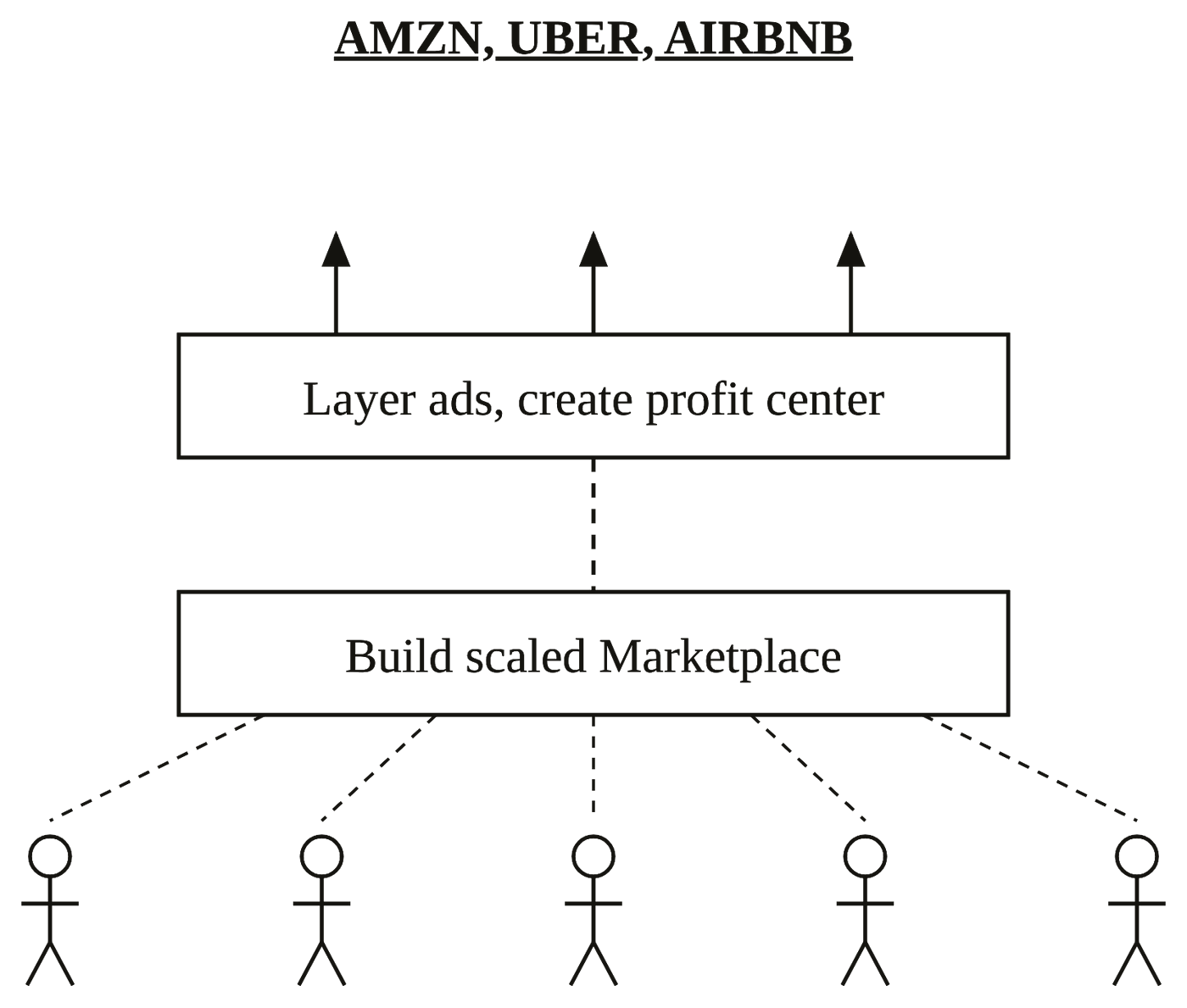
Advertising as a business model has a few great dynamics. Firstly, there is no cost to serve these ads on your platform, so there is inherently 100% margin. As your platform and its attention grow, so does your advertising business. While there are businesses that are fully advertising companies, such as Meta and Alphabet, albeit the latter has diversified somewhat into other forays.

I think what is more interesting are companies such as Uber, Amazon, Instacart, and potentially Airbnb because advertising is the hidden profit engine that allows these businesses to thrive, albeit unintentionally. Yet to create a successful ad business, you need scale; Amazon has to grow the size of its retail business and introduce third-party sellers, which allows a near $ 70 billion ad business in 2025.

That drives a core part of Amazon’s free cash flow, more than retail itself or AWS, yet you need to first establish a thriving marketplace in order to create a killer advertising product. Uber has an ad business at a 2 billion run rate, which makes up a majority of its profits. Delivery, Mobility, and Freight are all just a front. Once you can capture users’ attention through the value proposition, eg. I want late-night wings, you can create a valuable ad product.

So from a strategy perspective, Uber should continue to add businesses such as its partnership with Expedia to create greater user attention, which further grows their ad business, which rewards their shareholders. Something Airbnb has struggled with. It's rather a communications problem and a failure to get a real CEO, which Uber, thanks to some poor management skills of its founder, was able to force its founder out and build a real defensible business, with Dara Khosrowshahi.

Airbnb’s promoted listings opportunity

So what opportunity does Airbnb possess? The same that Uber did when they launched their ad business. Airbnb has created a two-sided network of Hosts and bookers. They charge fees on both sides and really have created a great business. I am in no way trying to undermine a company doing 4.5 billion in free cash flow. Yet the travel industry is inherently cyclical, and costs related to fees and damages are unstable.

Airbnb should create a promoted ads business for its bookings. A business that can comfortably bring in around $ 1 billion in revenue, based on an Uber-comparable in terms of ad revenue as a % of GBV? This would stabilize net income and free cash flow, which have been volatile at times, and overall strengthen the predictability of future cash flows, giving shareholders confidence and improving shareholder returns.

Figure 1
Disruption

Why OpenRouter Could Become a Great Platform

I think of OpenRouter as a great business.

July 17, 2026

I think of OpenRouter as a great business. It aggregates practically every Large Language Model, then bundles access and takes a flat fee. Their main value proposition for an enterprise is cost savings. They give you clear access to every model and allow you to judge the optimal use for your business. It makes accessing models extremely easy and developer-centric, yet jeopardizes the position of the frontier labs. Today, The Information broke news of acquisition interest in OpenRouter.

Platform economics and model commoditization

Shocker: while I can speculate on who might be interested, what is clearly more interesting is why anyone would want to buy OpenRouter. here Simply for two reasons: firstly, it has clear platform dynamics. It is an aggregator of AI models, and once enterprises use it, that creates switching costs since all your AI expense is in one place: logs, budgets, etc, so switching would be painful and generally not make a lot of sense. That’s clear, hence the 1.3 billion valuation.

But it’s interesting for the interested acquiring parties because OpenRouter threatens to commoditize Anthropic and OpenAI. For most enterprises, the differentiation between these models is thin, and considering that yesterday Kimi K3 beat a lot of benchmarks and for a fraction of the cost, albeit speculated distillation, it further proves why OpenRouter should be a dominant business. So perhaps a frontier lab is hoping to acquire them to defend themselves from becoming a utility.

Or maybe Google, which led OpenRouter’s 113m series B. So it would likely be a big mistake to sell, considering the amount of leverage the company currently has. The reason a commodity business would be bad for a frontier lab is that the fixed cost investment of training needs to be spread across as many enterprises as possible, yet if a platform has hundreds of models and many, if not most, being cheaper, it’s hard to command any pricing power at all. And all the capital invested in these labs would essentially be useless since growth would falter, and the current valuations, which are way out of touch with reality, would crash.

Acquisition value and the case for remaining independent

In terms of valuation, their latest round was in May at 1.3 billion. Given the market and the dominant position of the company, 40 to 50 x their revenue, which was last stated at somewhere around 50 million. So in the range of 2 billion. Yet if they can aggregate the demand of the enterprise world and take a comfortable 5.5% on every company's model usage, OpenRouter could become a cash-printing machine, far more value-accretive than a measly 2 billion exit. So the recent Stripe acquisition talks around the 10 billion number seem expensive, based on their recent 140 million in ARR. But they are growing rapidly; their revenue was 40 million in November, so around a 17% monthly growth rate. Here is a

conservative revenue forecast

OpenRouterProjected financials
Metric202620272028
Revenue (ARR)$140M$280M$490M
Growth-100%75%
Gross Profit (85%)$119M$238M$417M
Operating Income (40%)$56M$112M$196M
Free Cash Flow (35%)$49M$98M$172M
OpenRouterProjected financials
Metric202920302031
Revenue (ARR)$784M$1.14B$1.54B
Growth60%45%35%
Gross Profit (85%)$666M$969M$1.31B
Operating Income (40%)$314M$456M$616M
Free Cash Flow (35%)$274M$399M$539M

This assumes that OpenRouter becomes a great enterprise software company, but not the dominant platform it appears to be becoming. Revenue is likely 3 to 4 billion in that scenario. Plus, Stripe is not trying to maximize FCF; rather create strategic enterprise lock-in and layers on additional services. It also views OpenRouter as a dominant player in the AI era, and can use it as a beachhead to add on Stripe services.

Figure 2
Disruption

Nintendo’s Transition Into a Media Company

Nintendo is moving towards a more diversified media company.

July 11, 2026

Much discussion has been about how Nintendo has under-monetized its IP and its stubbornness in sticking to the console + high-margin software business. Yet Nintendo has built a console platform with its own rich first-party IP, plus a third-party developer ecosystem for indie and middle-market games.

What is the future, and can there be real shareholder value created? The case is not that Nintendo is cheap simply because it owns great characters. The question is what it can earn from those characters over time, without weakening the games that made them valuable.

Nintendo does not have to constantly maximize short-term revenue. Rather than put its characters everywhere and dilute them, it can be selective about how it uses them. That patience is part of the thesis, but it also means shareholders cannot assume every opportunity will be monetized as quickly as possible.

Revenue is still cyclical. New console generations bring hardware launches and a new software cycle, while the later years of a console's life can look very different. Nintendo is moving towards a more diversified media company. IP is a cornered resource; that is the main power/moat Nintendo really has. Its ability to use its IP in theme parks, movies, TV shows and collectibles will help define the future of the business.

Games at the center of the media flywheel

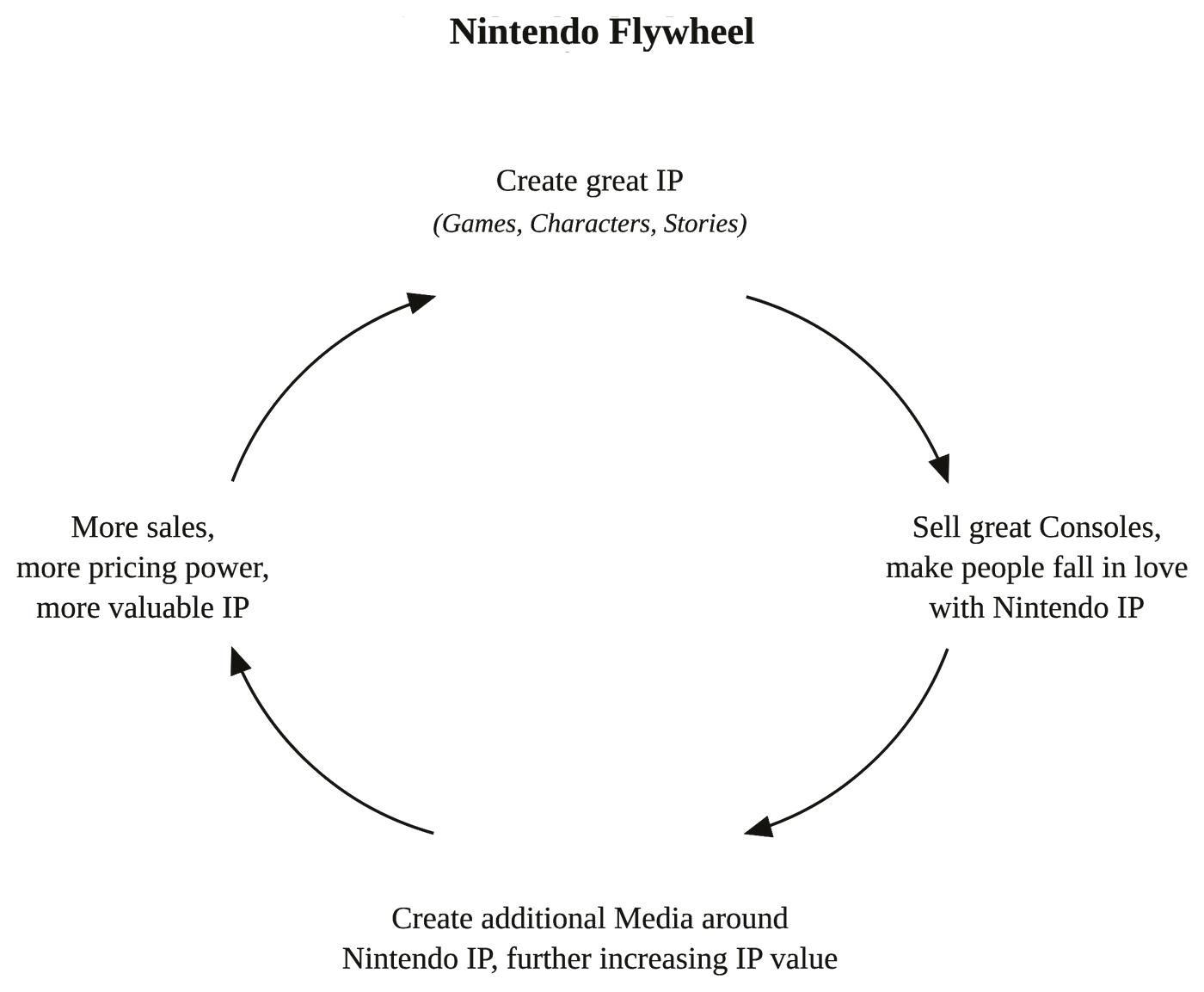
Similar to Disney, the core of the flywheel for Nintendo is making great games. Building games, marketing them to consumers and creating stories has built this collection of IP. Movies give the characters another way to reach people. But box-office success is not the same as Nintendo's revenue or profit, and the investment case should not depend on an assumed cut of ticket sales.

The theme park agreement with Universal gives Nintendo another channel for its characters. This is a different model from owning and operating the parks itself. The opportunity is to earn from the IP without carrying all the costs of the distribution channel. I would not put a precise annual parks estimate into the thesis without disclosed economics.

Beyond that are collectibles and Nintendo's interests in The Pokemon Company. Nintendo Switch Online offers a recurring subscription and access to older games. This is largely nostalgia-fueled, from the days of playing on the Game Boy and the NES. The important point is the ability to keep earning from the same characters and game library, not an estimated subscription run rate.

Reducing dependence on the console cycle

By becoming a media company, Nintendo can try to rely less on console cyclicality and focus on what it has done for generations: make great games, characters and stories. Digital software, subscriptions and licensing could improve the revenue mix. That is an opportunity, not a claim that media already dominates the business or that the console cycle has disappeared.

Hence the case for a long-term free cash flow business with less dependency on each new console generation. The closest comparable to this vision of Nintendo is Disney, although their economics are different. Nintendo's core business is still making great games and consoles, with fixed costs and booms and busts. The media flywheel can create shareholder value if a wider audience turns into sustained profit. If it does not, this remains a cyclical console business with great characters.

Nintendo flywheel: great IP, consoles, additional media, and more valuable IP
Nintendo's flywheel. The games remain the starting point.
Disruption

Xbox, Game Pass, Aggregators, and Free-to-Play

Xbox has had messy restructuring recently, and it is sort of the end of the Game Pass era.

July 9, 2026

Xbox has had messy restructuring recently, and it is sort of the end of the Game Pass era. The business model on paper made sense; if anything, it is the ideal model on paper: games should be bundled rather than bought for 60 bucks a pop. But video games are inherently not ephemeral, and the desire is not really the content.

Free-to-play games and Steam’s distribution advantage

It is really more about the social interactions and the desire to experience what one believes they never could in reality. This is compounded by the gains made in free-to-play gaming. This is the ideal business model in general. Virtual goods have effectively no COGS and have pricing power. This leads to another problem with Game Pass being that an aggregator already exists in gaming, which is Steam.

Steam used the great form factor of the internet to disrupt the traditional distribution model and allowed game developers to go direct to consumers. This essentially created reinforcing network effects for Steam and created the gaming store for the internet. So, in an industry where PC is the dominant platform. And F2P games dominate the vast majority of gamers, what role does Microsoft play? Sony, on the other hand, has focused on creating exclusive games such as Spider-Man.

Game Pass and the cost of aggregation

This creates a real reason for a gamer to buy the Playstation, for the game. Now, arguably, Xbox should have just done the same and focused on first-party exclusives. Instead, they tried to build a aggregator, but the problem being is that developers and console makers are all incentivized to sell expensive games individually. So Microsoft decided to acquire game studios, most notably Activision Blizzard. But the problem again is that games do not have the same dynamic as Netflix and movies and TV shows.

Much rather, most games around 60% only buy a couple games a year, so Game Pass is not really worth it. And the hardcore gamers, which are a much smaller subset of the market, will probably make up a large part of the 30m subscribers. Although Microsoft has a history of overstating numbers, so perhaps even that is exaggerated. The thing with subscription business models is that you want as many customers as possible to amortize the cost; in Microsoft's case, a very expensive cost around 80 billion in total game studios.

Xbox’s remaining strategic options

So by creating a product only a subset of the market would use, they set themselves up for failure. Overall it has been a struggle, and the recent layoffs do not really help. That raises the question why in the world even keep pursuing this. Because Xbox was started to keep Windows from becoming irrelvant as a distribution stratgey. Now Windows is not the core business at all, keeping Xbox seems dumb.

But they have a huge sunk cost fallacy with all the studios they have acquired, so a spin off or selling the entire business largely would not command the premium that the IP they own really deserves. So likely they will focus on creating Xbox exclusives to increase sales, and also keep Game Pass going anyway, considering it’s on a 5 billion run rate. Regardless, Microsoft’s acquisition of Activision Blizzard will go down as an example of poor capital allocation and poorer strategy.

Some rough math, assuming a 30% margin on Game Pass, they have likely made around 20 billion since the inception in 2017. That is 6 billion in profit, and user growth has already stalled. So the path ahead is financially daunting. A Strategy that has worked is Riot Games and League of Legends, which intentionally started the studio from the perspective of the free-to-play business model, combined with the internet for distribution and the virtual goods model, has made League of Legends one of the highest-grossing games ever. It is an example of what an internetenabled business really allows. So with declining Xbox sales, Microsoft's gaming division is really a game studio, and to compete with Tencent, they will have to release free-to-play games.

Figure 1

Links

https://www.videogameschronicle.com/news/more-than-60-of-us-game-players-only-buy-two-games-or-fewer-per-year-survey-finds/

https://abovethecrowd.com/2009/03/09/how-to-monetize-a-social-network-myspace-and-facebook-should-follow-tencent/

M&A & Consolidation

Why Dropbox Is an Obvious Private-Equity Target

I have been doing research on companies, reading 10-Ks, etc.

July 6, 2026

But as of late, reading the 10-K and seeing the slowing growth, there was not much to be optimistic about. Again, Steve Jobs was right: Dropbox was indeed a feature, not a Product, and clearly the wave of enterprise companies that were features that IPOed and struggled is many. Thus, I have a thesis of a wave of consolidation in this sector. And SaaS generally has had a history of strategic consolidation.

Dropbox would not be a strategic acquisition since most of the major enterprise companies already have a solid storage business. But it does throw off cash, and a lot of it. In FY2025, it threw off 931 million in free cash flow. From a Hamilton Hemler perspective, their main power is to allow for sustainable long-term cash flow, which would be switching costs. Once a smb embedes their documents with Dropbox and uses it to manage all their work documents, it creates a switching cost because of the complexities in switching and the harm it could cause in switching; apart from that their is no real other power. The switching costs do allow pricing power, but that is likely fragile.

But while this is no revenue-growing juggernaut, it’s a stable, cash-rich business, which is the kind of ideal target for the likes of a Silver Lake to acquire. And the valuation is cheap, making the debt load ratio reasonable, and use the close to one billion to pay down the debt. You could also take an aggressive approach in reducing headcount and cutting R&D. The product has largely remained the same, and there has not been much innovation since the founding.

In terms of an exit strategy, there will probably not be a re-IPO, and finding another acquirer is also improbable. So likely just harvesting cash is the ideal play. So now here are some rough numbers. As of the time of writing, the Enterprise Value is 6.43 billion. Assuming a 25% premium, the price would be around 8 billion. The FCF growth has been strong, around a 10% 3-year average, and 7% in 2025. Assuming a forward 5-year 3% growth rate.

Assuming 60% debt, 4.8 billion, and the rest in sponsor equity. Overall consolidation is cyclical, and there are periods of IPO booms and many new companies, and then bear markets where the Berkshires of the world buy great assets at even better prices. But a lesson from this story is twofold: when Steve Jobs tries to buy you, take it. Economically, the return from a capital efficiency standpoint would be much better. Second, public companies that are truly just a feature never give you great returns.

Disruption

Snapchat’s Shift From Advertising to Subscriptions

April 21, 2026

Snap Inc.’s business model is changing. Wall Street has tagged the company as an advertising company, which has been the dominant model for most of the company’s short time in the public market (9 years). But over the last two years, it has seen growth in one segment that is unrelated to advertising and has a marginal cost of selling near zero. Snap+ is the subscription business for Snapchat’s app. I believe that this is the future; most tech companies’ dominant revenue today comes from a second business like AWS or Windows.

The limits of Snapchat’s advertising business

Snap Inc currently has advertising as its dominant revenue source. And it has a unique offering through its AR filters, as a way to display ads, along with real estate in the apps, Maps, and contacts, and through its feed of videos. Snap had 5.9 billion in revenue in FY2025. Ads were 87% of revenue. I view this business as the legacy business, and I expect revenue to still come from it at a high rate, but the higher-margin revenue and the growth driver will come from Snap +.

The reason why the ad business has struggled compared to Meta is structural. Meta has products that, with every interaction, give them more data about a user, whereas Snap’s core value proposition is how everything is temporary, and they are a messaging platform, so there is inherently much less data anyway. Apple’s ATT privacy rules have further impacted Snap’s ability to track data, which helps it sell targeted ads, which is much harder for Snap than for its competition. Snapchat + is a subscription service where users get experimental, pre-release, and exclusive features.

Snapchat+ pricing and subscription economics

Annual Plan - $2.25/mo Monthly Plan - $4.49/mo Lens+ - $7.99/mo

Platinum - $13.49/mo Family Plan - $6.49/mo Snap has provided guidance that “direct revenue” will have a 1 billion annualized revenue run rate in 2026. The key thing is that the marginal cost to serve the next user for this is near zero. The only real cost is the cut they pay through Apple.

Snap Inc. - Subscription Business ProjectionsFY 2024
MetricQ1 2024Q2 2024Q3 2024Q4 2024
Other Revenue ($M)87107123143
Subscribers (M)9.410.312.014.0
Blended ARPU / Month ($)$3.09$3.46$3.42$3.40
YoY Revenue Growth194%194%194%194%
ARR Run Rate ($M)348428492572

FY Total Other Revenue ($M): 460

Snap Inc. - Subscription Business ProjectionsFY 2025
MetricQ1 2025Q2 2025Q3 2025Q4 2025
Other Revenue ($M)152175190232
Subscribers (M)15.016.020.024.0
Blended ARPU / Month ($)$3.38$3.65$3.17$3.22
YoY Revenue Growth194%194%194%194%
ARR Run Rate ($M)608700760928

FY Total Other Revenue ($M): 749

Snap Inc.FY 2026 (Projections)
MetricQ1 2026Q2 2026Q3 2026Q4 2026
Assumed YoY Growth Rate60%55.0%46.0%50.0%
Projected Other Revenue ($M)243271277348
Projected Subscribers (M)26.028.030.032.0
Projected Blended ARPU / Month ($)$3.12$3.23$3.08$3.63

FY 2026 Projected Revenue ($M): 1,140

Figure 2

Network effects support the subscription business

Snap has the network effects currently for this transition to work. Advertising is sound, it’s just harder for the platform as stucturally the lack of targetted data. The combination of both can make Snap a great business, and the stock should recover well.

Figure 3
Figure 4
Capital Cycles

UnitedHealth: Value Trap or Undervalued Compounder?

UNH, a Steady Compounder At a Discount

March 31, 2026

Summary

  • UNH has seen several negative events over the last three years, such as an antitrust investigation, the CEO’s assassination, and increased medical costs, leading to a high MLR.
  • All of this has led to a near 60% draw down in market cap value. UNH has several competitive advantages that include being vertically integrated, which allows it to price insurance lower than the competition. As well as a proprietary data arm through Optum Insight.
  • While the CMS rate increases have caught management off guard, they are well- positioned to rebound in the following fiscal years, with a seriously strong fundamental business centered around their interconnected multi-segment business, which is unique and differentiated in the industry. Attempts to copy the UNH business model have failed; CVS Health is a prime example.

Recent Catalysts/Events

  • In late 2023, the company’s earnings report began to show an increase in Medicare utilization.
  • October 2023, the DOJ launched an antitrust investigation into the company.
  • In January 2024, the company reported the highest MLR of 85% since the pandemic.
  • February 2024, the DOJ reopens anti-trust investigation. Full year 2024, earnings fall 36%, MLR increases 2.3%.
  • December 4th, Brian Thompson, CEO of UnitedHealthcare, is assassinated. Public sentiment against healthcare companies is clear: Healthcare is “Evil”, this is held up by the support shown for Luigi Mangione.
  • Q1 2025, earnings guidance, they disclose they have been caught off guard by Medicare utilization rates and expect costs to increase by 6.5 billion.
  • 2025 has been full of CMS rate cuts and spending cuts on Medicare by the Trump admin. All of these events have caused serious volatility that has led to a 57% draw down from its Nov 29, 2024, $610 high, to today at 259 at the time of writing.

Business Overview

UNH is a healthcare and well-being company. They have two distinct lines of business. UnitedHealthcare is their healthcare leg, and Optum, which delivers value-oriented care. Optum Health is a health service business operating on value-oriented care; it has seen significant headwinds in the previous fiscal year. Optum Insight is the data & analytics arm, which sells to clinics and hospitals. This is the smallest of the three businesses, but Optum Bank, which was previously part of Optum Health, has been restructured and is now a part of Optum Insight. OptumRx is the PBM; this is the largest business of the three and faces PBM regulations.

Financials

  • Revenue in 2025: about $447.6 billion, up roughly 12% year over year. Profit in 2025: about $12.1 billion, down from $14.4 billion in 2024.
  • 2025 MLR guidance: 86.5% midpoint, up from 85.5%. The balance sheet has remained largely the same from 2024 to 2025.
  • Optum Health had seen an 8 billion dollar swing in profitability from 7 billion in operating income in 2024, to -270 million in 2025. This is largely due to cuts in Medicare funding and increases in overhead costs.
  • Due to the rising costs, UNH is exiting 100 Medicare Advantage plans across 109 counties in the U.S, exiting less profitable lines of insurance.

The key thing here is the net income compression, which is in parallel with the compression in free cash flow, just to prove there are no outliers. The market sentiment is not wrong; MLR has increased, and as expected, net income has decreased. The key idea is that if CMS rates are reset every year, the MLR increase is temporary. This is an industry-wide occurrence, and MLR increase is not an unusual thing; such has happened in previous periods in the company’s history.

Competitive advantages

  • UNH has a massive scale. They are the largest healthcare conglomerate; because of the scale, they have leverage and pricing power, and lobbying power within the government.
  • They have vertical integration since they provide healthcare insurance, and they are a healthcare provider. This allows them to have a lower cost structure. Their organic vertical integration has proven strong, as competitors like CVS Health face difficulties vertically integrating their insurance arm.
  • Optum Insight gives them a property data advantage, which In theory, should allow them to price better. Since CMS rates are reset each year, the Increase in medical costs should be a short-term problem.
  • An analogy for their business model is Amazon Retail and AWS. While not directly related, the insurance business is similar to retail because it has low margins, and little innovation has occurred in the healthcare insurance. While Optum is like AWS because it is a high-margin service business, which has a lot of growth, considering Optum Insight is pretty new and has been growing. Essentially, Optum allows UNH to take lower margins on United Healthcare, which gets more customers, which they can then deliver value-oriented care, which leads to higher margins.

Key Risks

  • The DOJ anti-trust case could potentially cause United Healthcare and Optum to break up, essentially erasing the vertical integration that has been their competitive advantage. In the case of a split, the healthcare segment as a standalone business would command a much smaller part of the market cap, because of its lower margins. Assuming OptumRx is also split up, it would likely be the largest of the companies broken out of UNH.Essentially, this is the key long term risk that is being ignored, and the medical costs, which are more short term is where the focus is. But the margin of safety gives me enough comfort to justify this risk.
  • The negative public sentiment around healthcare companies and the “aggressive coding” has led to a CEO assassination and could cause difficulties with regulators.
  • The current Medical Costs could become the standard, and this could be a drag on profits long-term.

Conclusion

Over the last 3 years, UNH has faced many adversities, resulting in negative sentiment and a rapid and significant stock decline. More recently, the Trump administration’s cuts in spending have created nervous sentiment around healthcare broadly. While the CMS rates have increased, because this is changed every year, the likelihood that this is a temporary increase, and that UNH should be able to price in this increased cost in the long term, is very positive. Regardless of the near 60% draw down in value, the fundamentals are intact; they have built a very strong moat around the Insurance castle. By vertically integrating, they have scale, which lowers costs, leverage with clinics and physicians, and they have a proprietary data advantage that will help them underwrite better. And most importantly, the flywheel that Optum allows increases customers, which increases margins through Optum. UNH is a long-term buy that should see a market correction.

Figure 1
Capital Cycles

When Investing Heuristics Become a Problem

And more random ideas.

January 26, 2026

I want to discuss this topic of heuristics. Some are helpful, some unhelpful. I’m borrowing a lot of this from Charlie Munger and Nick Sleep. Two investors whom I have tried to apply the philosophy they have in investing. So heuristics are shortcuts for investors. In my opinion, they prevent investors from doing the good and all-important homework that is necessary to make an educated investment. Obviously, by the price-to-earnings ratio, which is the expectations set by Wall Street, that is what is represented.

Price-to-earnings ratios and future cash flows

Often, that is a misconception, but those expectations are usually of the short-term-minded and often based on the intrinsic value, which is a bargain compared to the long term. Just think of the price-to-earnings of Costco in 1994 when Charlie became a board member; I estimate the price-to-earnings was between the mid-20s and low-30s. That’s irrelevant because today it is 50. Now I know that it is not the case every time, but people often look at the p/e and already decide if it is investable, which is a psychological misjudgment.

And a counterexample is where there is a low price-to-earnings ratio, such as with many memory stocks today, which people cite as a reason there is not an asset bubble. Yet when earnings are cyclically higher, the price-to-earnings ratio is lowest then. Hence, this becomes the value investor's trap. Price matters, but the size and development of the market and the company’s future strategy matter more.

Figure 1

Capital returns and intangible investment

A second example is capital efficiency returns. Although this heuristic is very helpful, one has to understand the background behind it. Because accounting does not include investments that increase intangible value, this becomes a crucial blindside for companies that have few tangible assets. Let us take Coca-Cola as a great example. If you studied the history of this great company, you would see that they intentionally decided to be asset-light, which focused them on producing syrup and marketing sugared water.

Hence, the investments in marketing would increase brand value but not increase ROIC or other such metrics. So while brand value has become one of the most recognizable, the ROIC would not reflect this. Today, because of the acquisitions they make, the ROIC is what it is. And a capital-intensive business may also have high returns on capital, but that also means that less cash is returned to investors. So your ROIC could be high, but if constant reinvestment is necessary, those industry dynamics aren’t ideal.

Overall, every company is unique in its situation; there is no easy playbook or checklist of things you can just pick off and then be done. Rather, you have to take a company that the market has not fully understood. Costco has been understood, so the alpha there is not great. But take Nintendo, for example, a company I wrote about here. Currently being valued similarly to the likes of SEGA, rather, it should be valued more like Disney, since it is becoming a flywheel media company. It’s rather taking a company and predicting where the future cash flows can come from and making a bet.

For informational purposes only. Not investment advice.