
I am writing this more for myself than for anything else. I believe it is important to have a clear idea of what my ideas are, simply for reference and record.
I invest over many decades.
This works for me because of my own independent structure. Mutual funds, hedge funds, other institutional vehicles, etc., cannot, because of their structure, which forces them to constantly have to find new ideas and sell old ones.
Unless you have a permanent capital vehicle, which really only works if you’re really small and you’re a closed partnership, for which you must earn much trust from family, friends, and colleagues, or you have immense record, skill, and status, which allows you to have leverage when establishing a fund. Chris Hohn of TCI is a prime example. Also, taking control of a textile manufacturing company and compounding it for decades seems to work okay.
Beyond that, investing over decades really requires a few things. A combination of extreme patience and focus, and the ability to stomach a lot of pain. The other is having great experience and understanding long-term qualitative aspects, which cannot really be modelled in Excel, and realizing how rare they truly are.
A great example of this is Coinbase. Anything crypto-related tends to brush a value investor the wrong way, so brace yourself. Coinbase has a lot of the qualitative ideas of a firm I would want to own for decades, if not forever.
It is always good to start with management, listening and reading what they have to say. The best management tends to think really long term, is motivated beyond just monetary needs (they tend to have enough), and is motivated by their vision of the world or industry they are trying to impact. As Armstrong describes, making a dent in the universe. The key example in this scenario is forgoing short-term profits for long-term profits and, instead of earning Wall Street satisfaction in the short term, compounding customer trust.
In a new asset class such as crypto, it is easy to fool, trick, and deceive to make a quick buck. Many have, and got away with it; others have not. A prominent competitor to Coinbase, which was a derivatives trading platform, misused customers’ trust and set the entire industry back.
Coinbase and Armstrong want to do the opposite; they are willing to forgo short-term fads that could make them great amounts and lose their customers great sums, and rather prioritize customers and their investments.
Brands tend to have different utilities; some signal to the world that the owner is sophisticated and of value, while others showcase trust. Different brand utilities command greater pricing power. The best brands in the long run tend to have a combination of great history, significant utility (whether it signals status or has great product quality), and trust that it delivers on its company promise.
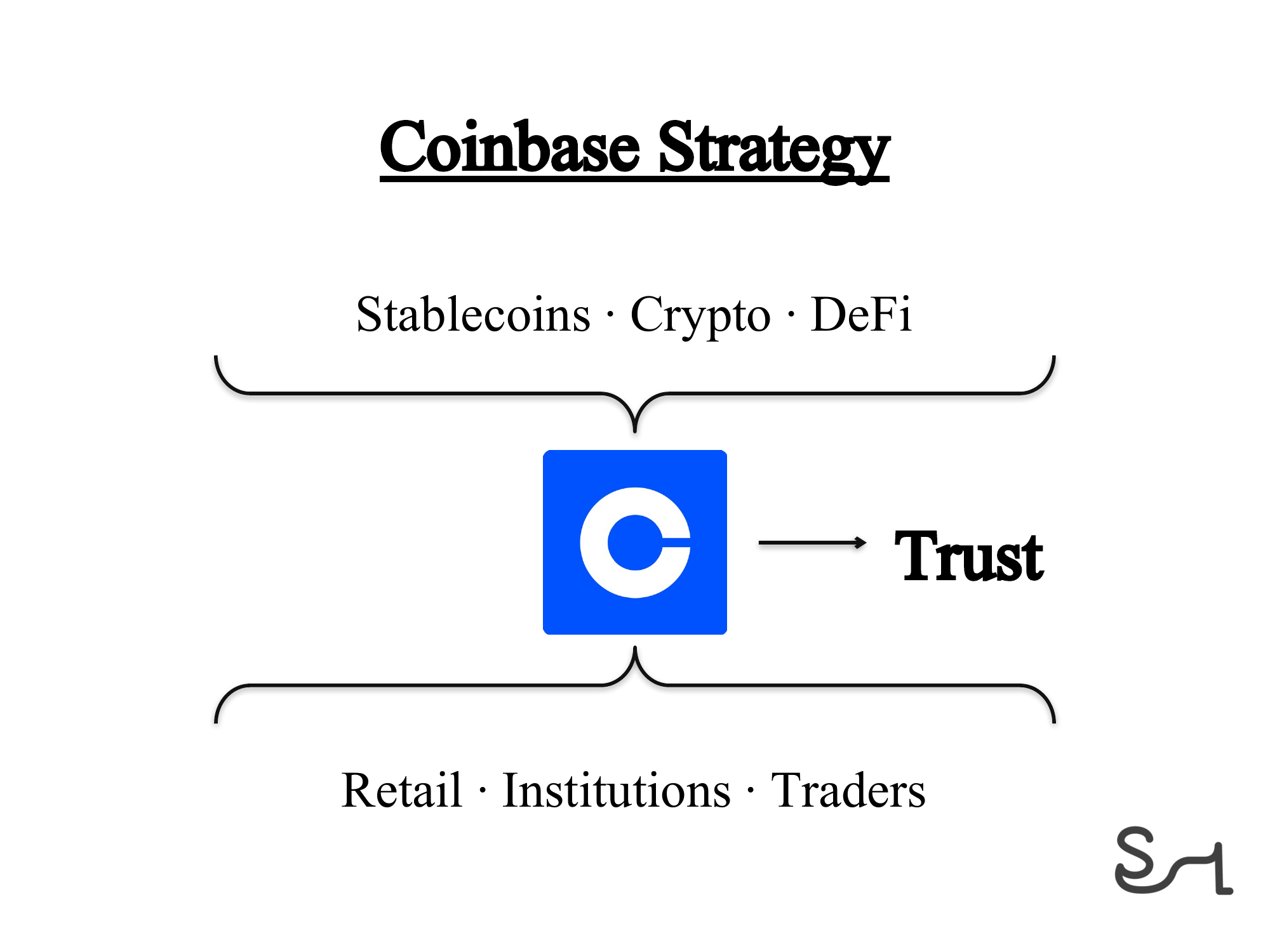
A common example that Munger uses is Wrigley’s gum, akin to a foreign competitor that is 20c cheaper. Coinbase is really a trust enabler. They have, in a new and volatile industry, been a benefactor for both retail and, more recently, institutional investors. This is why they have such great long-term potential to compound in an ever-growing industry as technology is actively improving the financial world.
I often think of Robinhood as a competitor. Which is incorrect; Robinhood is a one-layer play on a traditional service that incumbents dominate, leveraging a new technology wave. They will likely be acquired when their growth matures, because they really are a feature. A good business, just better suited within a larger financial institution. Coinbase is two layers deep, pioneering crypto while using mobile technology. Hence the potential for long-term compounding. The distinction is key: the greater the independence, and the difficulty of replication, the greater the pricing power. Josh Tarasoff talks about pricing power in three ways, the first being where a firm has no pricing power. Then nominal pricing power, where a firm can raise prices to keep pace with inflation; this is where Robinhood lies in the long run, at least on its own. Then there is excess pricing power, which is for great businesses with true differentiation; Coinbase is as such.
The future is cryptographic, for a ton of reasons.
The vision of management is bold and brilliant, yet somehow extremely grounded and long-term. Listening to Brian, you can tell he is grounded in the long term, willing to let competitors extract short-term value at the cost of their brands in the long run.
Coinbase takes the long-term approach; the acquisition of Deribit gives them an institutional business, albeit at a very high price, yet a necessary one, to prevent a competitor from owning it, since now Coinbase is the most trusted place for retail investors and institutional investors. Deribit is the clearest example. Coinbase paid about $4.3 billion at closing, up from the roughly $2.9 billion announced, because its share price rose. It was the largest acquisition in crypto at the time. Kraken had been in talks to buy Deribit for months and ended up buying NinjaTrader for $1.5 billion instead. It was a high price, but it bought the leading crypto options exchange, which handled over $1 trillion in volume the year before. (Source: Coinbase Global, Inc., Form 10-Q for the quarter ended September 30, 2025, Note 3, “Acquisitions - Deribit”, filed Oct. 30, 2025, https://www.sec.gov/Archives/edgar/data/1679788/000167978825000208/coin-20250930.htm) As the asset class grows, and institutions continue to trade crypto and broader commodities with the growth in prediction contracts, Coinbase will stand to benefit. They constantly introduce new financial products that leverage blockchain innovation, such as tokenized stocks. The goal is to make economic freedom available all around the world.
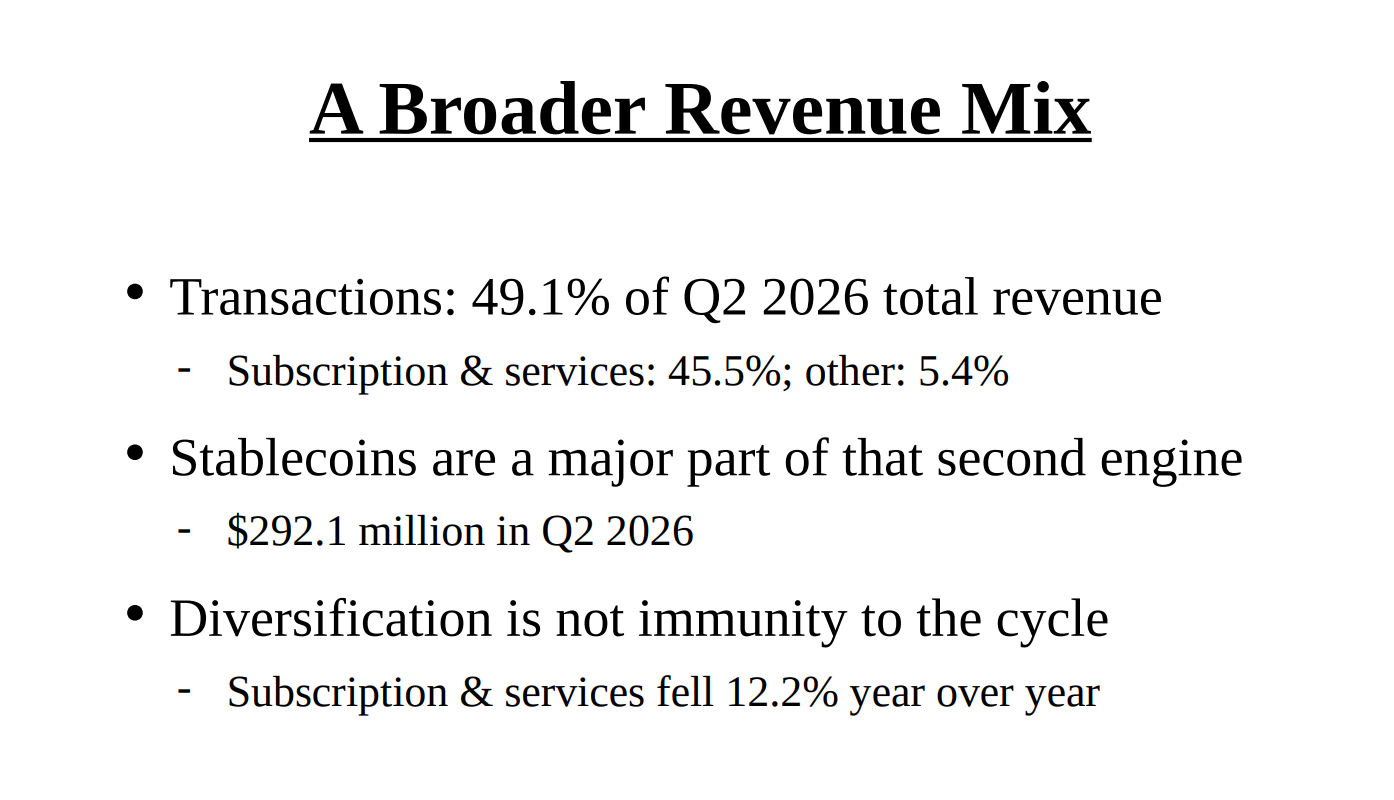
While the market still heavily links Coinbase to the trends of cryptocurrencies, Coinbase has successfully diversified, leveraging the growth and regulatory approval of stablecoins and introducing a subscription business.
This has stabilized its once heavily dependent transaction-revenue business. In Q2 2026, transaction revenue was around 50% of net revenue, with the rest being interest income and subscription revenue.
We hit an all-time high in the number of Paid Coinbase One Subscribers by introducing new tiers and increasing the value proposition with products like Coinbase One Card. Our ability to scale and diversify is driving results; we now have 12 products that generate more than $100 million in revenue on an annualized basis, half of which generate more than $250 million, and two that generate more than $1 billion.
Coinbase Shareholder Letter Q4 2025. The 12-product figures are measured using quarterly annualized net revenue for each product's most recent qualifying quarter, not full-year revenue.
Brian says and does the right things that many other CEOs have reminded me of, such as Bezos. He is committed to doing the correct thing, which will benefit shareholders in the long run, avoiding traps that may be beneficial in the short term but destructive to the brand in the long run.
The brand is the clear pillar of this company; as goes the brand, so goes the company.
Coinbase facilitates trust for institutions and retailers who want to invest in crypto, a $2.9 trillion asset class (as of Oct 4, 2026). Coinbase holds bitcoin, showing its trust in the innovation. It is not a debate whether bitcoin is a better option than the dollar; inflation will be a problem of the past, and Coinbase stands to benefit.
While recent fiscal quarters have struggled due to the broader crypto market, the continued diversification and recurring revenue and profits of Coinbase in the long run will prove well.
Overall, Coinbase is an example of an interesting concept. The intangible value of Coinbase’s brand enables trust. Trust therefore enables pricing power, since it is the key differentiation between Coinbase and other smaller, less-known crypto platforms. Coinbase's pricing power is the key enabler of long-term cash flows that will compound the firm's value. Other firms can do the same in technology waves: those that build trust with consumers and enterprises and constantly regain the relationship.
An example of this is IBM, which built great trust in the early pc era; when Gerstner arrived in the 90s, they were able to regain this relationship by building a services business which helped the same enterprises deploy this technology. Hence, this concept of trust is one of the strongest kinds of brands.
However, a brand and trust can always be destroyed through poor actions. Thus, the management team of the firm you believe has this brand power plays a crucial role, as they decide how long this valuable brand image, which enables pricing power, which in turn enables long-term cash flows of the business, will last. In my judgment, this character and long-term owner-minded thinking exists within Coinbase management, which begins with Armstrong. I look forward to enjoying seeing the value of Coinbase compound.
For informational purposes only. Not investment advice.