
“The essence of what’s going on here, of course, is we have a corporation that was in a branch of the newspaper business, and our branch of the newspaper business, like most newspaper businesses, has gone to hell compared to what it was in its peak years. And almost every other newspaper business is going to hell with no pardon, they’re just disappearing. What we have is this computer software business where we’re serving the same customers to some extent, except now they’re all over the country, even some of them outside the country, with this...we were selling software to all these courts and public agencies, whereas before we were giving information to lawyers and other people and publishing public notices.
And our software business is of a type where it’s a long, tough slog, but we’re slogging very well and we really love the people who are doing it for us. We’ve got a lot of wonderful people and in our software business, the implementers and the computer programmers and the people that deal with the public agencies, and the ethos of the place is very admirable. Everybody’s trying to get ahead here by doing the work right and serving the customers right and having a lot of financial wherewithal where money is never a problem and doing what we’re supposed to do. And so, it’s a pleasure to people like Rick Guerin and myself to watch all these young people doing this, and of course we’re very glad to be able to do it when we should be dead [laughter].”
Charlie Munger on the DJCO software business, DJCO Annual Meeting (2017)
Fall is when a business’s future gets decided
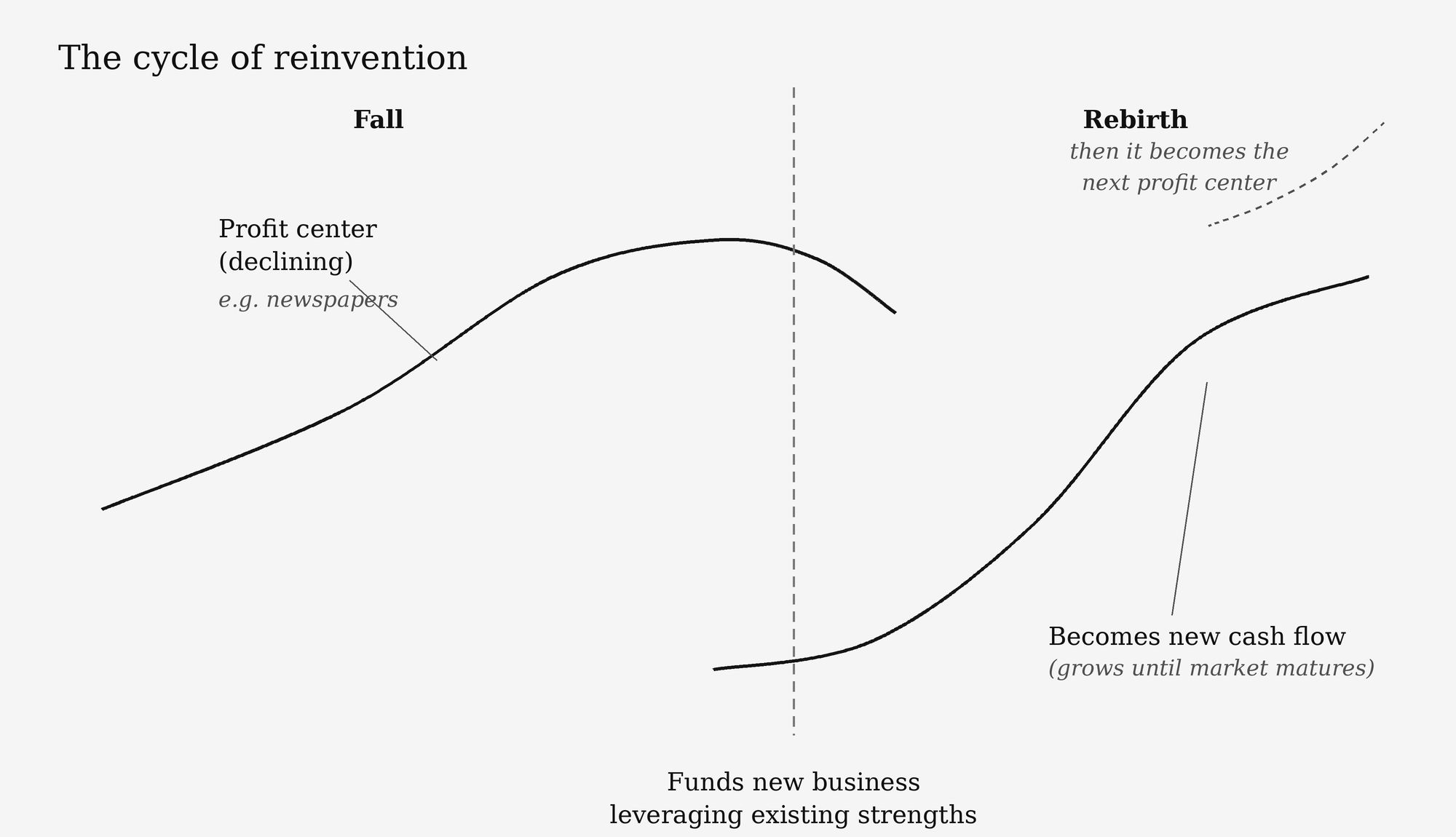
Fall is a wonderful time of year, especially in a place like Michigan where you get all four seasons. Leaves become vibrant colors, and one can admire the beauty of nature. Fall in a business analogy is a period of decline for a business, where a once profitable business has either matured and growth has plateaued, or has begun its decline as technology brings change, and goes out with the old, in with the new.
Fall in the business cycle is the crucial period in which a firm’s future existence is decided. If a business cannot scramble and use the declining cash cow to fund a transition to a new business leveraging existing strengths, then they will be all but a nostalgic corporate relic. The last few decades of DJCO have been in such a rebirth, leveraging the dying newspaper business and leveraging their strength in selling information to lawyers to create software to modernize the analog information they once sold to the courts.
| FY 2009 | FY 2017 | FY 2025 | |
|---|---|---|---|
| Traditional Business revenue (newspapers, public notices) | 35,481 | 17,570 | 17,762 |
| Journal Technologies revenue (court software) | 4,943 | 23,814 | 69,938 |
| Total revenues | 40,424 | 41,384 | 87,700 |
| Software share of revenue (computed) | 12% | 58% | 80% |
| Traditional Business pretax income | 12,931 | (360) | (165) |
| Journal Technologies pretax income | 17 | (12,142) | 12,660 |
| Net income (loss) | 8,026 | (918) | 112,137 |
| Cash and marketable securities | 62,127 | 232,649 | 513,564 |
In fiscal 2009 the software segment was reported as "Sustain"; it merged with New Dawn and ISD on October 1, 2014 to form Journal Technologies (FY 2017 10-K). FY 2009 liquidity is cash plus U.S. Treasury notes and bills plus marketable securities, as grouped in that 10-K; FY 2017 and FY 2025 are cash plus marketable securities at fair value. Net income in FY 2025 and FY 2017 includes realized and unrealized gains and losses on marketable securities. Software share row computed from the filed figures above.
Sources: Daily Journal Corp. Form 10-K for fiscal 2009 (filed December 15, 2009), fiscal 2017 (filed December 13, 2017), and fiscal 2025 (filed December 29, 2025), SEC EDGAR, CIK 0000783412.
DJCO is a great example of a successful transition into a new business, leveraging an existing strength. The key formula to successfully transition into a new technology millennium is existing capital, often through a declining profit center, + an existing strength which gives you the ability to create the new business. Without the existing strength, you're just a well-funded startup. The key advantage is your existing strength. DJCO was selling newspapers to lawyers and firms, which gave them important information about courts. So having these relationships with the courts proved key when they began to sell software to modernize the courts and their data.
Untapped pricing power is the asset
Would you rather own a firm which is constantly increasing prices, and its customers for the most part, until recently have dealt with it, and the firm’s revenues and profits have increased dramatically?
Or would you own a firm that has increased the price very little, if at all, yet has great customer relationships, and a well-known brand?
The answer is, most obviously, the latter. Untapped pricing power is a phenomenal state for a firm to be in when you invest. You are at a point where you have created much intangible equity with your customers, where you can implement great price increases in excess of inflation and see little to no backlash. Truly, the market is your oyster.
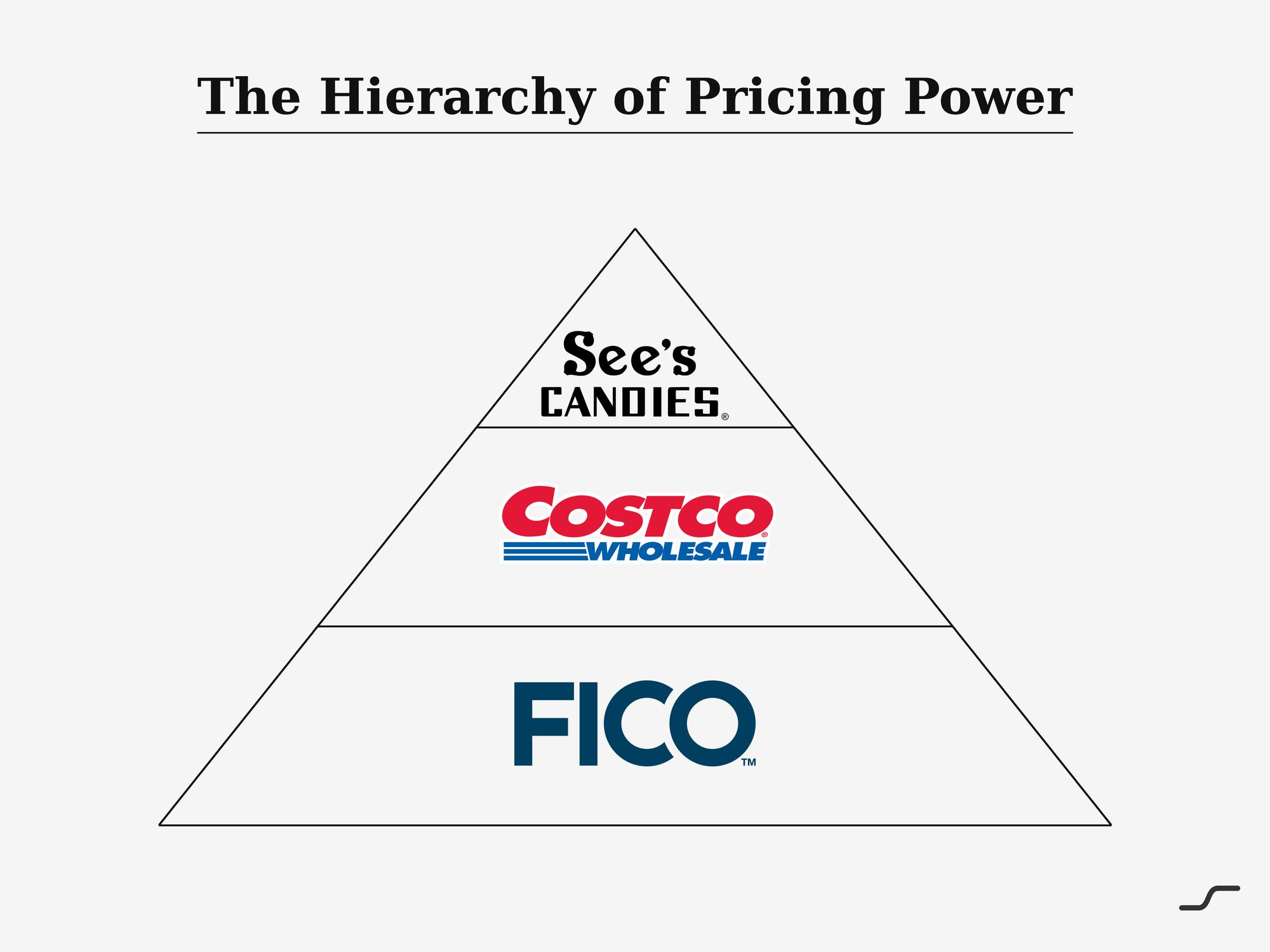
Pricing power also has hierarchies, and it is important for management to understand where the present business actually stands within the implied hierarchy. Overestimate pricing power and your customers will engineer a new solution that routes around you. Underestimate, and you may be considered incompetent, but at least the business retains the intangible equity. If anything, delayed gratification is good; Costco is a good example of this: they have disciplined management that raises prices only every few years, and if so, nominally to keep pace with inflation. This is long-term accretive because it keeps existing customers extremely loyal and allows for new customers to join by keeping barriers low. Over time, customer dependence increases, making it harder to churn in the future if management chooses to tap pricing power.
There are really two ways to assess the effect on shareholders’ returns due to pricing power. Either you buy an ownership position in a business when the pricing power is untapped, and you see a catalyst, or management has begun to raise prices. The obvious benefit is that the increased revenue growth and increase in the bottom line will drive your return over the long term.
Another indirect way to leverage pricing power is to use the Costco model and basically create all the scenarios for untapped pricing power, but delay it through the concept of “Scale Economies Shared” (Nick Sleep), and let the market realize the beauty of your business and therefore receive a premium in your valuation.
FICO: the role model for the worse
Costco and See’s Candies are examples of the good, but who is a role model for the worse?
Fair Isaac Corporation (FICO) comes to mind. You have to place yourself in the shoes of a mortgage company and think: you probably are annoyed that a cut of your transactions goes to FICO for their scoring services. That should tell you that FICO most definitely did not have the level of pricing power that See’s Candies does. Maybe someone should have alerted present management to this when they went on a spree of price hikes over the last decade or so. Forcing regulators to introduce the 2018 Credit Score Competition Act, allowing new competition, which they validated in 2022 with VantageScore 4.0.
With new competition, prices will inevitably decline, and for the foreseeable future, the Scores business should decline. The decline will be a long one, because there are deep institutional ties; this business will not disappear overnight. Equifax is slashing prices to $4.50, half of FICO. Clearly, the business will not disappear overnight, which is the beauty of the situation. FICO’s scoring business makes up roughly 80% of its segment operating profit, with little capex attributable; the high-margin business can safely fund the SaaS expansion over the next decade.
The declining scores business funds the software rebirth
The SaaS business is where DJCO collides. Similar to the DJCO story, FICO management has built a new SaaS business platform which is growing, and they are actively moving away from the legacy non-platform SaaS business.
| 2023 | 2024 | 2025 | |
|---|---|---|---|
| Platform software | 154,750 | 200,004 | 237,056 |
| Non-platform software | 485,432 | 511,336 | 503,089 |
| Total | 640,182 | 711,340 | 740,145 |
| Platform share of software revenue | 24% | 28% | 32% |
Source: Fair Isaac Corporation, Form 10-K for fiscal 2025 (filed November 2025), SEC EDGAR, CIK 0000814547.
Platform software, which is the new cloud-based software business that sells analytics to the same customers, credit bureaus, etc. The platform helps customers manage data, fraud protection, etc. Leveraging the existing customer base and leveraging the same model analysis and customer integration from the scores business to sell similar modular capabilities on a recurring revenue basis, plus additional usage fees for specific contracts.
A new business is not a new business model
There are real differences between developing a new business, and a new business model. Amazon building AWS is a new business, whereas creating an ads marketplace is a new business model. It is far easier to create a new business model to extract value on an existing customer value proposition in the short term. But in the long run the value extraction will be net-negative on the sustainability of profits of the business if the additional business model has no customer benefit. Building a new business leveraging existing strengths allows for greater sustainable profits, short term upfront investment but greater longer term longevity within the new business.
Not every set of management is capable of such a transformation, simply because it is difficult and requires accountability. It is far easier to introduce a subscription product or an ad product on an existing marketplace, then build a new business if necessary.
You can commend Mark Zuckerberg as a great example of this, but there is a fine line between conviction and stupidity.
FICO is interesting because it represents an entire palette of investing and business ideas. It has a cult value investor following for all the dying legacy reasons; it has a turnaround story (Who doesn't love a good turnaround story? I sure do…), and it has one of those scary yet innocent fables for what can happen when management overestimates pricing power. It really has it all.
For informational purposes only. Not investment advice.
Sources
Daily Journal Corp., Form 10-K, fiscal 2025
Daily Journal Corp., Form 10-K, fiscal 2017
Daily Journal Corp., Form 10-K, fiscal 2009
Fair Isaac Corporation, Form 10-K, fiscal 2025
Equifax press release, October 7, 2025: VantageScore 4.0 at $4.50
Charlie Munger, Daily Journal Corporation Annual Meeting transcript, 2017